Week 8 · Medieval
8th centuryAD 701–800
 About this artwork →
Church life
- In 719 Pope Gregory II sent the English monk Boniface to bring the Christian faith to the peoples of Germany. The pope told Boniface to teach the faith of the Holy Trinity. He also told him to keep the sacraments (Baptism and the Lord’s Supper) as Rome kept them. Boniface later swore loyalty to the pope, so the new churches were tied to Rome. P: Gregory II’s letter of 719 and Boniface’s oath V1: Catholic Encyclopedia, Boniface, Roman commission V2: Schaff IV, §25, Roman commission. Schaff gives 718. The primary selection and the Catholic Encyclopedia give 719. The sources agree on the commission, not on the year.
- Frankish rulers and the pope became allies. Pepin the Short asked Pope Zacharias to recognize his rule as king of the Franks in 751 and 752. In 754 Pope Stephen II crossed the Alps to ask Pepin for help against the Lombards, a Germanic kingdom in northern Italy. In 773–774 Charlemagne, at Pope Hadrian I’s request, conquered the Lombard kingdom. P: Einhard, Life of Charlemagne, §§1, 6 V1: Catholic Encyclopedia, Charlemagne, Lombard wars V2: Schaff IV, §57, Pepin and the papacy. Einhard credits Stephen with ending the old royal line. Schaff credits Zacharias. The sources differ on which pope acted.
- Alcuin of York, an English deacon and scholar, became Charlemagne’s teacher and the head of his palace school after they met in 781. His schools began a Frankish revival of learning. In 796 he became abbot of St. Martin’s at Tours. P: Einhard, Life of Charlemagne, §25 V1: Catholic Encyclopedia, Alcuin V2: Schaff IV, §57, Charlemagne’s schools.
- John of Damascus defended Christian images against iconoclasm (the rejection and destruction of religious images). He wrote under Muslim rule near Jerusalem, out of the emperor’s reach. His main argument rested on the incarnation: God became a visible man in Christ, so Christ can be pictured. P: John of Damascus, On Holy Images, Parts I–III V1: Catholic Encyclopedia, John Damascene V2: Schaff IV, §§101–104.
- In 781 Christians in Tang China set up a stone monument in Chang’an (now Xi’an). Its text, written by a priest of the Syriac-speaking Church of the East, tells how a missionary arrived in 635. It confesses the Trinity and says the Messiah “appeared in the world as a man,” born of a virgin. Opponents called this church “Nestorian,” but that label does not describe all it believed. P: Xi’an inscription, 781 V1: Scott Fitzgerald Johnson, Silk Road Christians, abstract V2: Catholic Encyclopedia, Nestorius and Nestorianism, missionary expansion.
Controversy and heresy
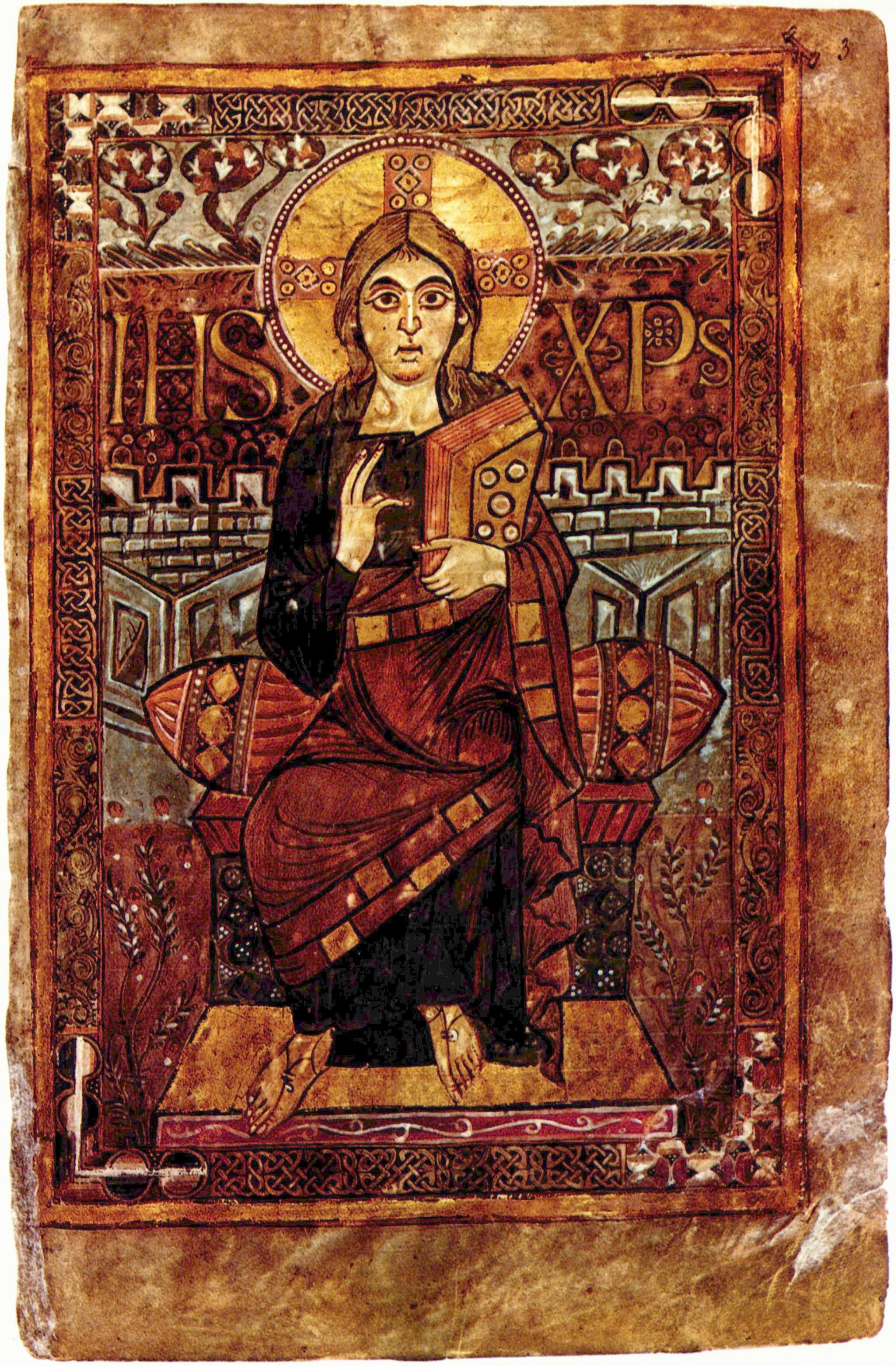
- Iconoclasm began in the Greek-speaking East. Tradition dates Emperor Leo III’s first edict against religious images to 726. His son Constantine V carried the policy on, and the dispute ran through most of the century. Iconoclasts said images were idols. Their defenders said the incarnation of the Son of God made pictures of Christ lawful. P: Definition of the council of 754 V1: Catholic Encyclopedia, Iconoclasm V2: Schaff IV, §101.
- Adoptionism was a Spanish teaching that Christ, in his human nature, was God’s Son only by adoption and not by birth. Elipandus of Toledo and Felix of Urgell taught it. A Frankish synod at Regensburg in 792 and the synod at Frankfurt in 794 condemned it. The Frankfurt letter answers that the Son born of the Virgin is truly God, one person who is both God and man. P: Frankfurt letter, Denzinger §311 V1: Schaff IV, §§117–118 V2: Catholic Encyclopedia, Adoptionism.
- Teaching question: Does an image point to Christ, or does it become something people trust in his place? Compare John’s argument with the Nicaea II definition and with the First Commandment. P: John, On Holy Images, Part I P: Nicaea II, Definition, Lutheran norm: Large Catechism, First Commandment.
Councils and major events
- Hieria, 754: Emperor Constantine V called about 340 bishops to a synod at the palace of Hieria, near Constantinople. It banned religious images and declared itself the seventh ecumenical (worldwide) council. Rome and the other great sees did not take part, and Nicaea II later overturned it. Its argument was about Christ: a picture of him either mixes his two natures or splits them apart. It called the bread and wine of the Supper the only true image of his body. P: Definition of the council of 754 V1: Catholic Encyclopedia, Iconoclasm V2: Schaff IV, §101.
- Lutheran classification: Spurious. Its central teaching goes beyond Scripture. It says images of Christ are idolatry. It says the priest makes bread and wine the only true image of his body. Lutherans agree only that trust in an image is idolatry. Luther holds that a council cannot set up new articles of faith. Large Catechism, First Commandment, Luther, On the Councils and the Church
- Nicaea II, 787: Empress Irene and Patriarch Tarasius called this council. Roman legates attended. It confirmed the creeds and the two natures of Christ, and permitted respectful veneration (honor) of images. It set that honor apart from the worship that belongs only to God. It was the last council that Rome and the East both number as ecumenical. P: Definition V1: Catholic Encyclopedia, Nicaea II V2: Sagovsky, §3.3.
- Lutheran classification: Mixed. The Confessions accept its creed and its two-natures confession of Christ. Lutherans can keep pictures of Christ. They reject its curses on those who refuse to honor images. They also reject its incense and lights, which the council tied to the prayers of saints. Augsburg Confession XXI says Scripture does not teach calling on the saints. Augsburg Confession XXI, Luther, On the Councils and the Church
- Frankfurt, 794: Charlemagne called this synod of Frankish bishops, with legates of the pope present. It condemned Adoptionism. It also rejected the decision of Nicaea II on images. The Latin copy the Franks read turned the Greek word for “veneration” into “adoration.” Treat this regional synod separately from Nicaea II. P: Synodical letter, §311 V1: Schaff IV, §§57, 104 V2: Catholic Encyclopedia, Adoptionism.
- Lutheran classification: Received. The Confessions teach the same truth that Frankfurt defended: Christ is one person, true God and true man, and is the Son of God by nature. The judgment covers only this Christological decision. Its image decree rested on the mistranslation, so it is not part of this judgment. Augsburg Confession III, Formula of Concord, Solid Declaration VIII
- On 25 December 800 Pope Leo III crowned Charlemagne emperor at St. Peter’s in Rome. Einhard says that Charlemagne disliked the title. He claims Charlemagne would have stayed out of the church that day if he had known the pope’s plan. The event joined the Frankish king and the Roman church under one imperial title. P: Einhard, Life, §28 V1: Catholic Encyclopedia, Charlemagne, Coronation as Emperor V2: Schaff IV, §57.
Major people
- Boniface (about 675–754), an English monk, is called the apostle of Germany. Willibald’s Life says he cut down the sacred oak at Geismar and built a chapel to the apostle Peter from its wood. In 748 or 747 Pope Zacharias made him archbishop of Mainz. He was killed by pagans in Frisia in 754 or 755. P: Willibald, Life of Boniface, Geismar episode V1: Catholic Encyclopedia, Boniface, oak episode and later life V2: Schaff IV, §25. Willibald’s Life tells the oak story, and the Catholic Encyclopedia gives both dates for Boniface’s death.
- John of Damascus: He argued that the Word took on visible flesh, so Christ can be shown in a picture: “I do not worship matter, I worship the God of matter, who became matter for my sake.” P: On Holy Images, Part I V1: Catholic Encyclopedia, John Damascene V2: Schaff IV, §§101–104. This is a reading assignment from his own text. The historical claim we verified is that he defended images.
- Bede (about 673–735), an English monk and historian, finished his Ecclesiastical History of the English People in 731. It is our main source for early English church history. P: Historia ecclesiastica V.24, DCCXXXI V1: Dickinson College, Preface, opening paragraph V2: Catholic Encyclopedia, Bede.
- Alcuin of York (about 735–804): Charlemagne’s chief scholar. He helped frame the Frankfurt decrees against Adoptionism. P: Einhard, Life, §25 V1: Catholic Encyclopedia, Alcuin V2: Schaff IV, §57.
- Charlemagne (king of the Franks from 768, emperor from 800): He called synods, backed missions and schools, and led the Frankish church in the West. P: Einhard, Life of Charlemagne V1: Catholic Encyclopedia, Charlemagne V2: Schaff IV, §57.
Wider world
- 711: Muslim forces crossed from North Africa and began the conquest of the Iberian Peninsula (Spain and Portugal). P: Ibn Abd al-Hakam, later conquest narrative V1: Schaff IV, introduction to the Middle Ages V2: Museu d’Història de Catalunya, opening paragraph.
- 732: Charles Martel, the Frankish ruler, defeated a Muslim army near Tours in central France and stopped its advance north of the Pyrenees. P: Arab chronicle of the battle V1: Catholic Encyclopedia, Charles Martel V2: Schaff IV, chronology of the Middle Ages.
- 793: Viking raiders attacked the island monastery of Lindisfarne off the coast of Northumbria. English Heritage dates it to 8 June. P: Anglo-Saxon Chronicle, annal 793 V1: English Heritage, Viking raid V2: British Museum/LGfL timeline, 793. The Chronicle manuscripts give the month differently.
Confessional Lutheran connection
- Christology: The one divine Son took on human nature. Compare this with the adopted-Son teaching. Read Augsburg Confession III and Formula of Concord, Solid Declaration VIII, especially §§6–14, which confess one person with two natures. P: Augsburg Confession III P: Formula of Concord VIII, Primary comparison: Frankfurt §311.
- Baptism: Mission work makes disciples by Baptism, God’s gift, and not by political loyalty. Compare Boniface’s mission with the promise attached to water and God’s Word. P: Augsburg Confession IX P: Large Catechism IV, §§6–17, Primary comparison: Gregory II’s commission.
- Lord’s Supper: The incarnate Christ gives his body and blood through bread and wine. Compare this with the council of 754, which called the bread and wine the only image of his body. Lutherans do not accept every argument for image veneration. P: Augsburg Confession X P: Formula of Concord VII–VIII, Primary comparison: Council of 754, Definition.
- Councils: This is the curriculum’s confessional judgment. Luther holds that no council can set up new articles of faith. A council only defends the old faith, as the four early councils did. Test Hieria, Nicaea II, and Frankfurt by that rule. Luther, On the Councils and the Church, Large Catechism, First Commandment
- Church and ruler: Charlemagne’s coronation raises the question of who rules the church. Compare it with Augsburg Confession XXVIII on the separate powers of bishops and rulers. P: Einhard, Life, §28 P: Augsburg Confession XXVIII