Week 7 · Early
7th centuryAD 601–700
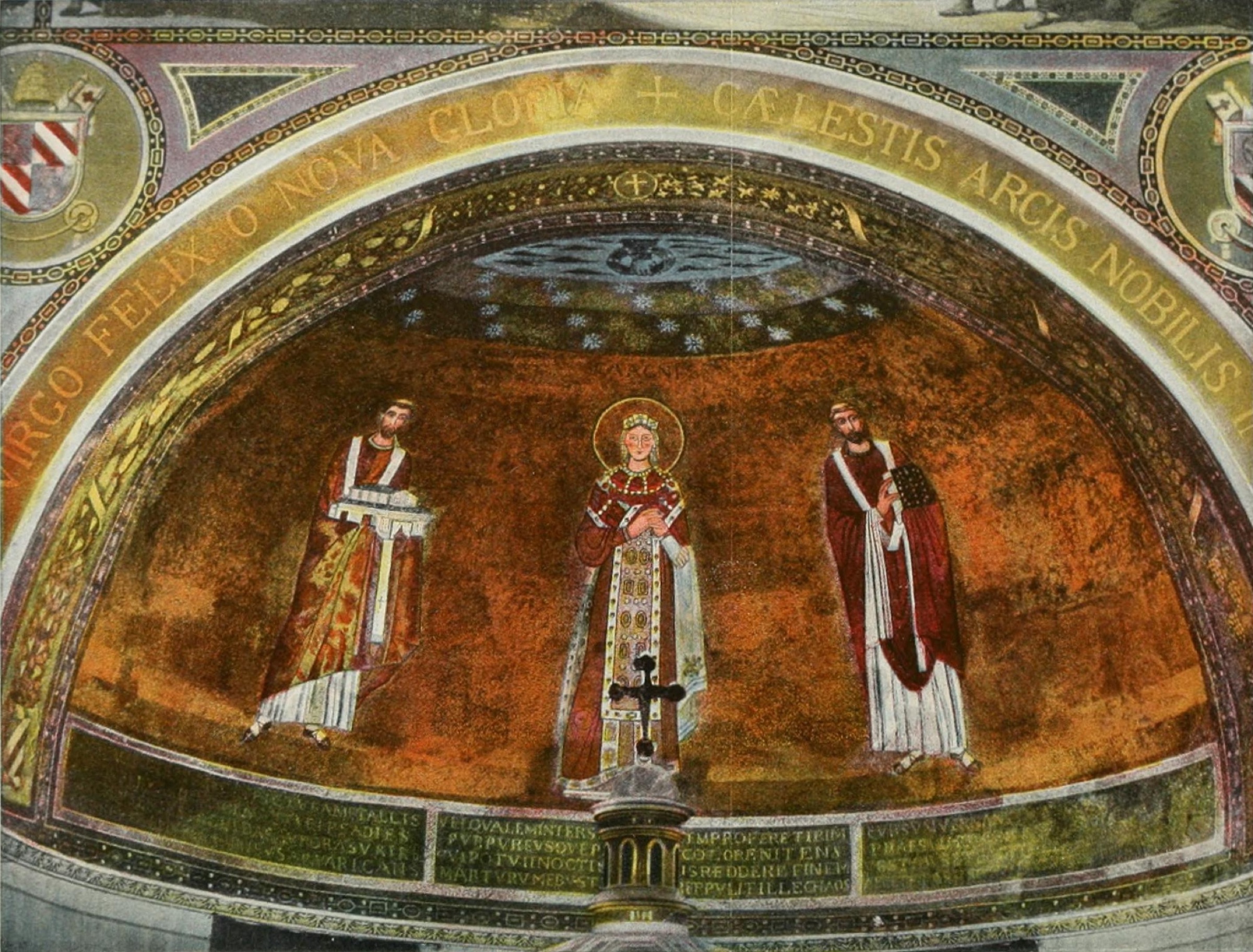 About this artwork →
Church life
- Hild’s monastery at Whitby, in northern England, housed both men and women. Hild had her community study Scripture. Its men served at the altar, where Christ gives his body and blood in the Lord’s Supper. Five of her monks became bishops. P: Bede, Ecclesiastical History IV.23, Hild’s monastery and its five bishops V1: Catholic Encyclopedia, Hilda, study of Scripture and five bishops V2: English Heritage, St Hild of Whitby, five monks who became bishops.
Controversy and heresy
- Monothelitism (the teaching that Christ has only one will) divided the church for most of the century. Its supporters wanted to protect the unity of Christ’s person. Its critics said that Christ must have a human will. Without one, he is not fully human and cannot save humans. Patriarch Sergius of Constantinople led the one-will side. Emperor Heraclius backed it in 638 with a statement of faith called the Ecthesis (“Exposition”). Emperor Constans II banned all debate in 648 with an order called the Typos (“Type”). One review dates the Ecthesis to 636, but most sources say 638. P: Lateran synod 649, Canon 18, Denzinger 271, naming Sergius, the Ecthesis and the Typos V1: John Chapman, Catholic Encyclopedia, Monothelitism, Sergius and the Ecthesis V2: Catholic Encyclopedia, Honorius I, the Ecthesis. The Pollard review gives 636.
- Constantinople III (see below) settled the question. It taught that Christ has a divine will and a human will. The two wills do not fight each other. P: Constantinople III, Definition of Faith and address to the emperor V1: Catholic Encyclopedia, Third Council of Constantinople, a perfect will in each nature V2: Thomas Aquinas, Summa Theologiae III.18.1, the sixth council and the human will of Christ.
- Pope Honorius I (pope 625–638) wrote letters to Sergius that seemed to favor one will in Christ. The sixth council later condemned him by name. Catholic writers still debate what his letters meant. P: Constantinople III, Definition of Faith, anathema on Honorius V1: Catholic Encyclopedia, Pope Honorius I, letters to Sergius and condemnation V2: John Chapman, Catholic Encyclopedia, Monothelitism, Honorius.
Councils and major events
- Lateran synod, Rome, October 649: Pope Martin I gathered 105 bishops. Their canons (church rules) teach that Christ has two wills and two kinds of action, one divine and one human. Through both he saves us. The synod was regional. Rome does not number it as an ecumenical (worldwide) council. P: Lateran 649, Canons 10–12, Denzinger 263–265 V1: John Chapman, Catholic Encyclopedia, Monothelitism, the two operations and the Lateran synod V2: Richard M. Pollard, review of Price, The Acts of the Lateran Synod of 649. Catholic Encyclopedia, Martin I adds the session dates.
- Lutheran classification: Mixed. The Confessions teach the same Christ: one person, two natures, born of the “always Virgin” Mary. That covers Canons 1–16. They reject Canons 17–20, which bind the church to every part of what the Fathers and councils handed down. Only the Word of God sets articles of faith. Smalcald Articles II.II.15 and Smalcald Articles I.4.
- Whitby, 664: King Oswiu of Northumbria held an assembly at Hild’s monastery to settle how to date Easter. The Irish-trained church kept one method, and the Roman church kept another. After hearing both sides, Oswiu chose the Roman method for his kingdom. Easter marks Christ’s resurrection, so the date mattered to the church. Do not describe the assembly as a change from one religion to another. Both sides were Christian. P: Bede, Ecclesiastical History III.25–26 V1: Catholic Encyclopedia, Synod of Whitby V2: English Heritage, Easter and the Synod of Whitby.
- Constantinople III, 680–681: Emperor Constantine IV’s council in Constantinople opened on 7 November 680. The Catholic Encyclopedia counts about 100 bishops at first and 174 by the end. Modern counts of the first session are lower. The council taught two natural wills and two natural kinds of action in Christ, without dividing his one person. Rome and the East both number it as the sixth ecumenical council. P: Constantinople III, Definition of Faith V1: Catholic Encyclopedia, Third Council of Constantinople, sessions and attendance V2: Thomas Aquinas, Summa Theologiae III.18.1, quotation and explanation of the two wills. Aquinas lived centuries later, so he shows how the council was received. The dates also appear in Sagovsky, Conciliarity, §3.3.
- Lutheran classification: Received. Its teaching of a human will and a divine will in one Christ follows from the Confessions’ teaching on two natures in one person. Each nature acts in fellowship with the other. The Confessions never name this council. They do not rule on its condemnation of Honorius. Formula of Concord, Solid Declaration VIII.46.
- Hatfield synod, England, 679 or 680 (sources differ): Archbishop Theodore led the English bishops to confess the Trinity and to accept the first five general councils and the Lateran synod of 649. Their statement also says that the Holy Spirit comes from the Father and the Son. P: Bede, Ecclesiastical History IV.17 V1: Encyclopedia.com, Hatfield, Council of, Theodore and the Monothelite concern V2: Orthodox Church in America, St Theodore of Tarsus.
- Lutheran classification: Received. It confesses the Trinity and the two natures of Christ. The Book of Concord’s Nicene Creed also says the Spirit proceeds from “the Father and the Son.” Nicene Creed, Book of Concord.
- Trullo (also called Quinisext, “Fifth-Sixth”), Constantinople, 692: Emperor Justinian II called about 215 Eastern bishops to write the rules (canons) that the fifth and sixth councils had left out. The East treats these canons as part of those councils. The West did not receive them. P: Trullo, Canons 1–2, 13 and 82–84 V1: Catholic Encyclopedia, Council in Trullo V2: St Andrews Encyclopaedia of Theology, Conciliarity, §3.3. Teaching prompt: Compare how the East and the West received this council.
- Lutheran classification: Mixed. The Confessions accept Canon 13, which lets priests and deacons keep their wives. They accept Canon 82, which tells artists to show Christ in human form, not as a lamb, because he became man. They accept Canon 84, which baptizes any infant not known to be baptized. They reject Canon 12, which orders bishops to leave their wives. They reject the rules on fasting and on eating blood (Canons 55 and 67). The church has no power to bind consciences with such human rules. Augsburg Confession XXIII, XXVI.
- The Dome of the Rock in Jerusalem carries a building inscription dated AH 72, which is AD 691–692. AH means the Islamic year, counted from the Hijra. P: Dome of the Rock inscriptions, outer octagon V1: Museum With No Frontiers, Dome of the Rock, date V2: Feras Hamza, To Hell and Back, Oxford thesis, Appendix 4, pp. 193–194. The year does not settle every question about the building phases. The inscription also calls Jesus only a messenger of God, so it speaks about who Christ is.
Major people
- Maximus the Confessor (about 580–662) taught that Christ has a divine will and a human will, matching his two natures. He wrote that “Christ in his two natures, wills and operates our salvation.” His complete works were not inspected, only the excerpt. P: Maximus, Dispute with Pyrrhus, PG 91.320c12–14, quoted in Allen and Neil, Development of Monothelitism V1: Benedict XVI, general audience on Maximus, 25 June 2008 V2: Catholic Encyclopedia, Maximus the Confessor. Under Emperor Constans II he was tried in 662, and his tongue and right hand were cut off. Catholic Encyclopedia, Maximus and Benedict XVI report this. No primary account was read.
- Pope Martin I (pope 649–655) gathered the bishops for the Lateran synod in 649. The emperor’s officers arrested him in 653, and he died in exile in the Crimea in 655. P: Liber Pontificalis, Life of Martin, section 76, the synod of 105 bishops V1: Catholic Encyclopedia, Martin I, the synod, arrest and exile V2: King’s College London, Prosopography of the Byzantine Empire, Martinos 6. Sources disagree about his exact death date. The Liber Pontificalis excerpt covers only the synod. Teaching prompt: Compare the account of a council of bishops with the conflict between church and emperor described in Pollard’s review.
- Pope Gregory the Great (pope 590–604) sent Augustine to England. Bede says Gregory died in 605, but the Catholic Encyclopedia gives 604. P: Bede, Ecclesiastical History II.1, Gregory’s death and his mission to the English V1: Catholic Encyclopedia, Pope St. Gregory I, 590–604 V2: Benedict XVI, general audience on Gregory the Great, 2008.
- Theodore of Tarsus became archbishop of Canterbury in 668, reached Canterbury in 669, and died in 690. He led the Hatfield synod, which received the Lateran synod of 649 and its teaching that Christ has two wills. P: Bede, Ecclesiastical History IV.1–2 V1: Catholic Encyclopedia, Theodore of Canterbury V2: Orthodox Church in America, St Theodore of Tarsus.
- Hild (about 614–680) was abbess (head of a monastery) at Whitby. She led the monastery where the 664 assembly met. She and her followers supported the Irish method of dating Easter. She died on 17 November 680. P: Bede, Ecclesiastical History III.25 and IV.23 V1: Catholic Encyclopedia, Hilda V2: English Heritage, St Hild of Whitby.
- Caedmon, a farm worker at Hild’s monastery, became the first named English poet. Bede says he turned Scripture into English verse. His songs told of Christ’s incarnation (becoming human), death, resurrection and ascension. P: Bede, Ecclesiastical History IV.24 V1: Tom Nancollas, Caedmon, Whitby and Early English Poetry, English Heritage V2: Whitby Museum, Caedmon.
Wider world
- Around AD 610, Muhammad reported his first revelation, according to Islamic tradition. Islam teaches that Jesus is a prophet and not the Son of God. So the rise of Islam raised the question of who Christ is for Christians under Muslim rule. This entry reports what Muslims believe. It does not say the claim is true. P: Sahih al-Bukhari, Vol. 5, Book 58, Number 190, revelation at age forty V1: Syed Muhammad Khan, Islam, World History Encyclopedia, revelation in 610 V2: Syed Muhammad Khan, Prophet Muhammad, World History Encyclopedia.
- In AD 622, Muhammad moved from Mecca to Medina. This journey is called the Hijra, and the Islamic calendar counts its years from it. P: Sahih al-Bukhari, Vol. 5, Book 58, Number 190, migration to Medina after thirteen years in Mecca V1: Syed Muhammad Khan, Islam, World History Encyclopedia, the hegira V2: Syed Muhammad Khan, Prophet Muhammad, World History Encyclopedia, migration to Medina. The historical accounts supply the calendar year.
- On 20 August 636, Muslim Arab forces defeated the Byzantine army at the Yarmuk River in Syria. Syria then passed to Muslim rule. P: Al-Baladhuri, The Battle of the Yarmuk and After V1: Syed Muhammad Khan, Battle of Yarmouk, World History Encyclopedia V2: EBSCO Research Starters, Battle of Yarmūk.
Confessional Lutheran connection
- Christology: The curriculum’s confessional judgment is that Christ’s human will matters because he saved us as a true man. Compare Constantinople III’s definition with Formula of Concord, Solid Declaration VIII.5–12. Ask why the Confessions say that his two natures act in fellowship.
- Lord’s Supper: Connect the one incarnate Christ with his body and blood in the Supper. Read Formula of Concord, Solid Declaration VIII.76–87 and VII.35–39.
- Baptism: Compare Trullo, Canon 84, which baptizes infants of doubtful baptism, with Augsburg Confession IX, which says children are to be baptized. Ask how Baptism gives God’s grace to children too young to speak.
- Human rules and the date of Easter: Whitby shows a dispute over a church custom. Compare it with Augsburg Confession VII, which says the church’s unity does not need the same human traditions everywhere. The Hijra and the Battle of Yarmuk have no direct tie to Christ or the sacraments, so this unit offers none for them.
- Teaching prompt: Locate Jerusalem on a Mediterranean map. Compare the Dome’s statements about Jesus with the Nicene Creed. First discuss what each text says about Jesus. Then draw conclusions about religious change.
- Teaching comparison: Use Caedmon to discuss teaching Scripture in everyday language. Write short teaching verses on Christ’s incarnation, Baptism and the Supper. Read Bede’s story of Caedmon and the Lutheran norm in Augsburg Confession III, IX, X and XXIV.