Week 9 · Medieval
9th centuryAD 801–900
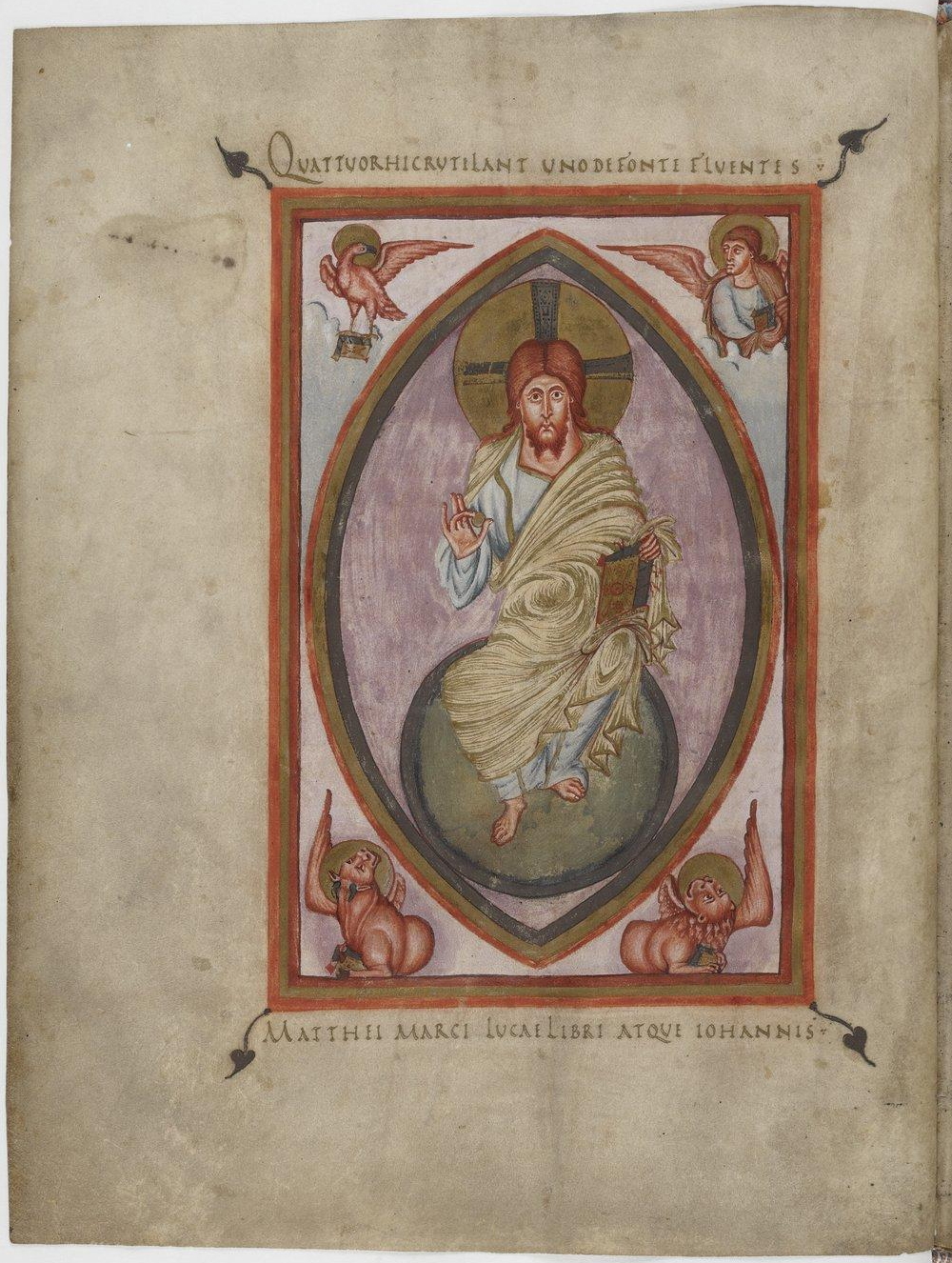 About this artwork →
Church life
- Slavonic worship: In June 880, Pope John VIII wrote to Prince Svatopluk of Moravia. He approved the Slavonic letters (the Glagolitic alphabet) that Constantine (later called Cyril) made. He allowed Mass, Bible readings, and daily prayers in Slavonic. The Gospel was read first in Latin, then in Slavonic. The letter lets the Slavs proclaim Christ’s deeds in their own language. So ordinary people heard Christ preached in words they knew. P: Industriae tuae, a Slovak translation of the Latin letter V1: Catholic Encyclopedia, Cyril and Methodius V2: Catholic Encyclopedia, John VIII. Around 873 the pope had banned Slavonic worship for a time, after German pressure. The 880 letter reversed that.
- Discussion: How do clear words, preaching, and the sacraments belong together? Compare the 880 letter with the Lutheran rule of worship in a language the people know. P: Industriae tuae P: Augsburg Confession XXIV P: Large Catechism, Baptism and the Supper.
- Guthrum’s Baptism: In 878, King Alfred of Wessex beat the Danish army at Edington. Its king, Guthrum, then accepted Baptism. Alfred stood as his godfather and lifted him from the font at Aller. Eight days later, at Wedmore, a closing rite of the baptismal week took place (the “chrism-loosing”). Asser, Alfred’s biographer, tells the story. P: Asser, Life of Alfred, year 878 V1: Catholic Encyclopedia, Alfred V2: 1911 Britannica, Alfred the Great. Discussion: Does defeat in war make a conversion real? How does the church teach Baptism to a ruler who was pressed to ask for it?
- Bulgaria and Baptism: Khan Boris of Bulgaria accepted Baptism from Greek clergy about 865. He then asked Pope Nicholas I for guidance. In 866, Nicholas sent 106 answers to Bulgarian questions. One answer covers people baptized by a Jew. A Baptism in the name of the Trinity, or of Christ alone, stands. It must not be repeated. P: Nicholas I, Responses to the Bulgars, chapter 104 V1: OCA, Cyril and Methodius V2: Catholic Encyclopedia, Nicholas I. The sources differ on dates. The Catholic Encyclopedia puts the Bulgarian embassy in 863, but the Responses are dated 866. Boris later chose the Eastern church.
Controversy and heresy
- Paschasius Radbertus and the Lord’s Supper: Paschasius was a monk of Corbie. He taught that Christ gives his real flesh and blood in the Supper. He did not mean only their power, or a picture of them. He wrote his book in 831 and revised it in 844 for Emperor Charles the Bald. He ties the gift to Christ’s words, “given for you.” P: Paschasius, Exposition on Matthew, PL 120, cols. 890–891, quoted in Schaff §126, note 708 V1: Catholic Encyclopedia, Paschasius V2: Harnack, History of Dogma V, pp. 315–317. Schaff only quotes the passage. His own opinion is not a primary source.
- Ratramnus and the Lord’s Supper: Ratramnus was also a monk of Corbie. Charles the Bald asked him to answer on this question. He taught that the body Christians receive in church differs from the body Mary bore, which rose from the dead. He called the bread and wine a “figure” and a “pledge.” He called the risen body “the truth.” Limit the summary to this point. P: Ratramnus, De corpore et sanguine Domini, chapters 88–89, PL 121, cols. 164–165, quoted in Schaff §127, note 711 V1: Catholic Encyclopedia, Ratramnus V2: Harnack, History of Dogma V, pp. 318–321. Historians disagree about his full meaning. Do not call him a Lutheran, a Calvinist, or a teacher of an absent Christ.
- Teaching question: How does each author relate the sacramental body to the historical body of Christ? What does each mean by “figure,” “truth,” and “spiritual”? P: Paschasius excerpt P: Ratramnus, chapters 88–89, Lutheran comparison: Formula of Concord VII, Lutheran comparison: Formula of Concord VIII.
- Gottschalk and predestination: Gottschalk was a Saxon monk. He taught “double predestination” (the claim that God chose some people for life and others for death). He said God chose the lost for death because he foresaw their evil deeds. He denied that God chose anyone for sin. A synod at Mainz condemned him on 1 October 848. Hincmar, archbishop of Reims, held him prisoner. A synod at Quierzy in 849 beat him, removed him from the priesthood, and ordered his books burned. He died in prison about 868. Rabanus Maurus, archbishop of Mainz, also opposed him. Hincmar taught that God wills all to be saved and that Christ died for all. P: Gottschalk’s shorter Confession, quoted in Schaff §122 V1: Catholic Encyclopedia, Gottschalk V2: Catholic Encyclopedia, Hincmar. The Catholic Encyclopedia doubts that his teaching was truly heresy. The 849 sentence also cited his irregular ordination.
- The Photian dispute: In 858, Photius became patriarch of Constantinople. He was a scholar and still a layman. Ignatius lost the office. Pope Nicholas I backed Ignatius and claimed the right to judge the case. A Roman synod in 863 declared Photius deposed. In 867, Photius led a council that declared Nicholas deposed. Both sides also argued over who led the new church in Bulgaria. The OCA says the 867 council also condemned the Filioque (the Western addition “and from the Son” in the Creed). Then Emperor Basil I restored Ignatius, and a new council met in 869–870. P: Acts of Constantinople 869–870 V1: Catholic Encyclopedia, Nicholas I V2: OCA, Photius. The acts come from the winning side. The OCA says papal legates at a council in 861 agreed that Photius was the rightful patriarch. Rome says the legates went beyond their orders.
Councils and major events
- Constantinople, 843 (a local synod): In January 842, the image-breaking emperor Theophilos died. His widow Theodora ruled for their young son Michael III. With Patriarch Methodios, she ended the ban on icons (holy pictures). A synod renewed the decree of Nicaea II (787). A procession then carried icons back into the church. The East keeps the day as the Feast of Orthodoxy, on the first Sunday of Lent. The argument rests on the incarnation. The Son became truly human, so he can be painted. P: Synodikon of Orthodoxy, early form V1: Catholic Encyclopedia, Iconoclasm V2: Orthodox Church in America, The End of Iconoclasm. The Catholic Encyclopedia dates the restoration to 842. Most modern accounts use 843. The Synodikon text grew over the centuries, so read only its early core.
- Lutheran classification: Mixed. The synod adds no new doctrine, and the Confessions share its base that the Son truly became flesh. They do not require honoring icons or calling on saints. Augsburg Confession III, Apology XXI
- Quierzy, 853 (a regional synod): Bishops loyal to King Charles the Bald adopted four chapters by Hincmar. They say God chose some for eternal life. They say God foresaw which people were lost, and he set eternal punishment for them. They say God wills all to be saved and that Christ died for all. P: Four chapters of Quierzy, quoted in Schaff §122, notes 687–689 V1: Catholic Encyclopedia, Councils of Quierzy V2: Catholic Encyclopedia, Hincmar. The tie to Christ is chapter 4. Christ died for all people, though unbelief keeps some from his gift.
- Lutheran classification: Mixed. The Confessions accept Quierzy’s teaching that God wills all to be saved, that Christ died for all, and that God does not predestine anyone to damnation. They reject its view that the will, once freed by grace, cooperates with grace toward salvation. Formula of Concord XI, Formula of Concord II
- Valence, 855 (a regional synod): Remigius of Lyon led this synod. It refused to approve Hincmar’s four chapters. Its canons teach a two-fold predestination, of the elect to life and of the wicked to death, with careful limits. The Synod of Langres repeated them in 859. P: Canons of Valence, Mansi XV, summarized in Schaff §122, note 685 V1: Catholic Encyclopedia, Hincmar V2: Schaff-Herzog Encyclopedia, Remigius of Lyons. The synod joins the same dispute about Christ’s saving work for all.
- Lutheran classification: Mixed. The Confessions agree that sin binds the will and that election is pure grace. They reject any predestination of the wicked to death. Formula of Concord II, Formula of Concord XI
- Constantinople, 869–870 (Rome’s eighth ecumenical council): The council met from 5 October 869 to 28 February 870. Legates of Pope Hadrian II presided. It condemned Photius, upheld Ignatius, and issued 27 canons. Canon 3 says Christians must honor the icon of Christ as they honor the Gospel book. The council also condemns those who taught that Christ’s body was only an appearance. Canon 21 forbids rulers to remove patriarchs and names the pope first in honor. Rome counts this council as ecumenical, and the profession of faith prescribed at Constance lists it as the eighth. The Eastern churches do not count it. P: Acts of Constantinople 869–870, canons 3 and 21 P: Constance, session 39, papal profession V1: Catholic Encyclopedia, Constantinople IV V2: Sagovsky, section 3.3. The council’s own claims do not prove that the whole church received it.
- Lutheran classification: Mixed. The Confessions accept its confession of one Christ, both visible and invisible. That matches Augsburg III. They reject canon 21’s ranking of the pope. They also reject canon 3’s order to honor saints’ icons, since they do not require icons or the calling on saints. Smalcald Articles II IV, Augsburg Confession III
- Constantinople, 879–880 (the Photian council): This council restored Photius. It confirmed Nicaea II (787). Its rule of faith (the Horos) keeps the Creed as received. It forbids writing another creed, adding to the Creed, or removing anything from it. Read these words before you decide what they mean for the Filioque. Legates of Pope John VIII attended. P: Horos, acts 6–7, in Dragas, part c V1: OCA, Photius V2: Słomski, The horos and the Creed. The Horos does not name the Filioque. How far its ban reaches is an open question. Dragas is an Orthodox priest and reads it as a ban on the Filioque. The Catholic Encyclopedia says only the Greeks count these Photian synods as the eighth council.
- Lutheran classification: Mixed. The Confessions receive the Creed that this council guards, and its Christ-centered faith. They do not read its ban on additions as a ban on the Filioque. The Book of Concord prints the Creed with “and the Son.” Nicene Creed in the Book of Concord, Augsburg Confession I
- Reception of the two councils: The 879 council cancelled the 869–870 council. Rome’s list kept 869–870. Many Greek Orthodox writers instead call 879–880 the eighth council. Compare the two lists and do not assume a shared numbering. P: Horos and Basil’s subscription, in Dragas, part c V1: Catholic Encyclopedia, Photian synods V2: OCA, Photius. A modern Catholic or Orthodox verdict is not the council’s own voice.
Major people
- Cyril and Methodius: These brothers came from Thessalonica. In 863 they went to Moravia. Constantine (Cyril) made the Glagolitic alphabet. The brothers translated the Gospels and church books into Slavonic, so the Slavs heard Christ’s Gospel in their own tongue. Cyril died in Rome in 869. Methodius became archbishop of Moravia and died in 885. P: Industriae tuae, alphabet and archbishop clauses V1: Catholic Encyclopedia, Cyril and Methodius V2: OCA, Cyril and Methodius. The two works differ on small points, such as whether Constantine began the alphabet before 863.
- Photius and Ignatius: Photius (patriarch 858–867 and 877–886) was a scholar and the rival of Ignatius. A council’s judgment is not a neutral life of the man it condemns. Compare the 869–870 acts with the Orthodox account. P: Acts of Constantinople 869–870 V1: Catholic Encyclopedia, Constantinople IV V2: OCA, Photius.
- Pope Nicholas I (858–867): He claimed the right to judge the Eastern patriarchs. He took the side of Ignatius and answered the Bulgarians’ 106 questions. He confirmed Ansgar as papal legate to the Danes, Swedes, and Slavs. P: Nicholas I, Responses to the Bulgars V1: Catholic Encyclopedia, Nicholas I V2: OCA, Photius.
- Empress Theodora and Patriarch Methodios I: Theodora ruled for her son Michael III after 842. With Methodios she ended the ban on icons. P: Synodikon of Orthodoxy V1: Catholic Encyclopedia, Iconoclasm V2: Orthodox Church in America, The End of Iconoclasm.
- Ansgar (801–865), “apostle of the North”: This monk of Corbie took the Gospel to Denmark and Sweden. In 831 he became the first bishop of Hamburg. Vikings sacked Hamburg in 845. He later served as archbishop of Hamburg and Bremen. He died on 3 February 865. Some Lutheran church calendars list him on that date. P: Rimbert, Life of Anskar V1: Catholic Encyclopedia, Nicholas I V2: New World Encyclopedia, Ansgar. Sources differ on the move to Bremen, between 847 and 849. Rimbert was his follower and wrote to honor him.
- Gottschalk, Hincmar, and Rabanus Maurus: These three men argued over predestination. See Controversy and heresy. P: Gottschalk’s Confession, quoted in Schaff §122 V1: Catholic Encyclopedia, Gottschalk V2: Catholic Encyclopedia, Hincmar.
- Paschasius and Ratramnus: Read both authors’ own words before you use later church histories. Ask whether a historian’s label fits the whole argument. P: Paschasius, commentary excerpt P: Ratramnus, chapters 88–89 V1: Catholic Encyclopedia, Ratramnus V2: Harnack, History of Dogma V, pp. 315–322.
Wider world
- 843: The Treaty of Verdun divided Charlemagne’s empire among his three grandsons. Lothair took Italy, the middle lands, and the emperor’s title. Louis the German took the east. Charles the Bald took the west. P: Treaty of Verdun, in Thatcher, document 17 V1: Larousse, Treaty of Verdun V2: 1911 Britannica, France: History.
- About 820: Al-Khwarizmi wrote a book on algebra in Baghdad, with the support of Caliph al-Mamun. The word “algebra” comes from its title. P: Al-Khwarizmi, Algebra, Rosen translation, preface V1: MacTutor, al-Khwarizmi V2: Encyclopedia.com, Muhammad ibn Musa al-Khwarizmi. The exact year is not certain.
- 878: Alfred the Great beat a Viking army at Edington. Its king, Guthrum, then accepted Baptism (see Church life). P: Anglo-Saxon Chronicle, annal 878 V1: English Heritage, early medieval introduction V2: Royal Household, Alfred biography.
- 868: A Chinese woodblock-printed Diamond Sutra (a Buddhist text) carries a printed date. It is the oldest known dated printed book, long before Gutenberg in Europe. P: Diamond Sutra colophon, in Linda Hall Library V1: International Printing Museum, The History of the Book, Part 1 V2: World History Encyclopedia, Diamond Sutra. Earlier printed pieces exist. This is the oldest dated complete book.
Confessional Lutheran connection
Each judgment below is the curriculum’s confessional judgment. It is not part of the history itself.
- Christology: Compare the confession of one Christ with the fights over who rules the church. Photius and Nicholas each claimed the right to depose the other. The Smalcald Articles say Christ alone is head of the church. Ask why winning a church fight does not prove a doctrine right. P: Augsburg Confession III P: Smalcald Articles II IV P: Formula of Concord VIII, Primary comparison: Constantinople 869–870.
- Baptism: Compare the Bulgarian and English stories with Christ’s promise in Baptism. The Trinity’s name and Christ’s word make a Baptism. The rank of the one who baptizes does not, and neither does the pressure of a war. P: Augsburg Confession IX P: Large Catechism IV, Primary comparison: Nicholas I, Responses, chapter 104.
- Worship in a known language: The 880 letter cites Paul on speaking in many languages. Augsburg XXIV also says that Paul commanded a language the people understand. P: Augsburg Confession XXIV, Primary comparison: Industriae tuae.
- Lord’s Supper: Compare the Carolingian excerpts with Christ’s words of institution. Lutherans confess the true body and blood of Christ in the Supper. Ask how the union of Christ’s two natures bears on the gift he promises. P: Paschasius excerpt P: Ratramnus, chapters 88–89, Lutheran norm: Augsburg Confession X, Lutheran norm: Formula of Concord VII, Lutheran norm: Large Catechism V.
- Predestination: Gottschalk looked to God’s hidden choice. Formula of Concord XI points to Christ, who calls all sinners and is the book of life. Ask why the Confessions send troubled hearts to Christ and not to a decree. P: Formula of Concord XI, Primary comparison: Gottschalk’s Confession.
- Councils: The Confessions do not name the councils of 843, 853, 855, 869–870, or 879–880. The classifications above weigh each council’s teaching against passages that the Confessions do cite.
- Wider world: The Treaty of Verdun, al-Khwarizmi, and the Diamond Sutra have no direct tie to Christ or the sacraments. They help place church events in time. Edington ties to Baptism through Guthrum.