Week 6 · Early
6th centuryAD 501–600
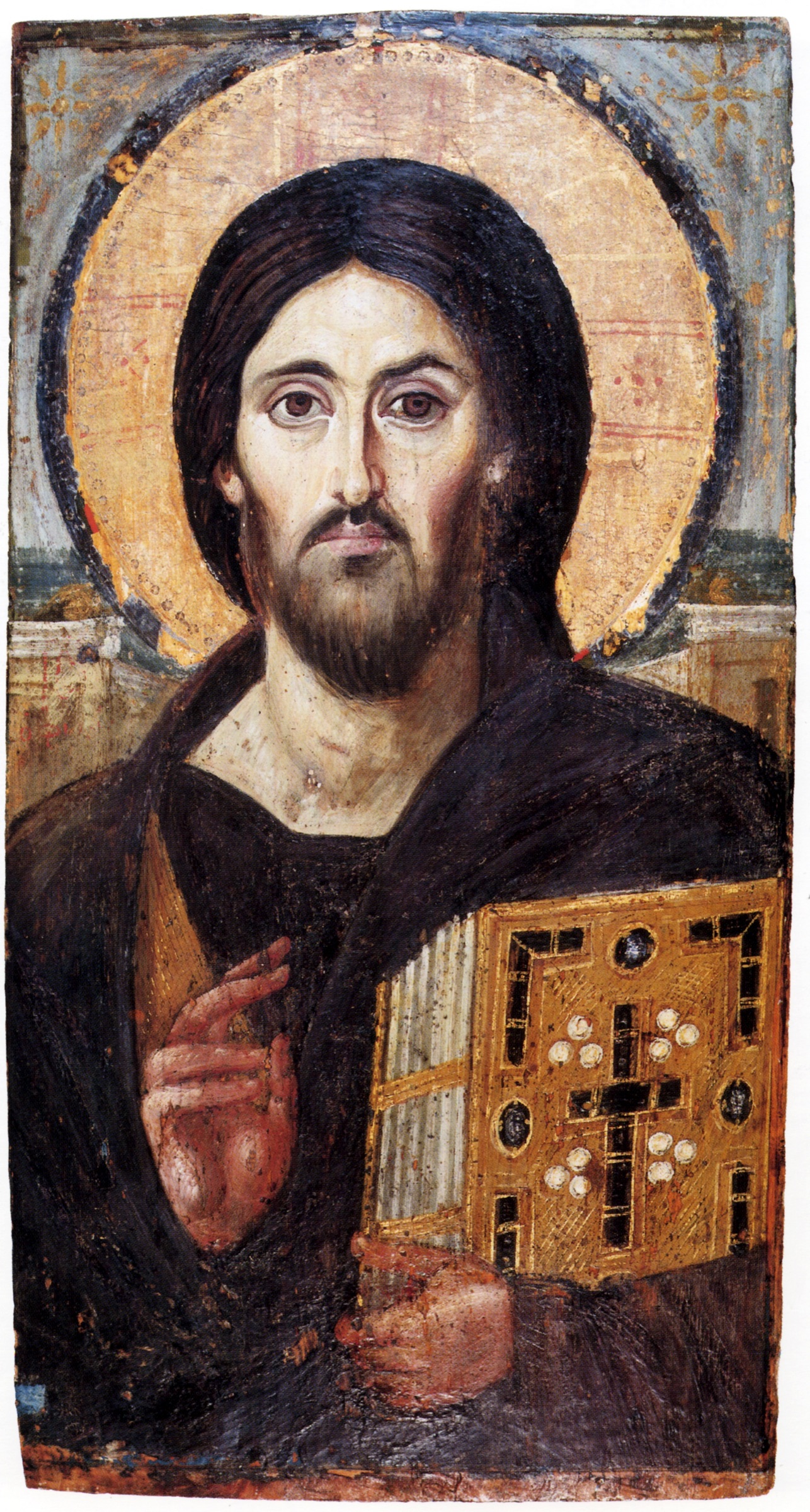 About this artwork →
Church life
- Augustine of Canterbury’s mission brought Baptism to the English. Pope Gregory sent Augustine and his monks to England, and they reached Kent in AD 597. King Æthelberht of Kent believed and was baptized, and many of his people followed. Bede does not date the king’s baptism. Later writers place it in 597. P: Bede, Ecclesiastical History I.25–26 V1: Catholic Encyclopedia, Augustine of Canterbury, Christmas 597 baptisms V2: Kent Archaeological Society, Augustine of Canterbury and the Saxon Church in Kent.
- Benedict’s Rule gives monks a daily mix of prayer, Bible reading, and manual work. Chapter 48 sets hours for work and hours for sacred reading. P: Rule of Benedict 48.1 and its daily schedule V1: Catholic Encyclopedia, Rule of St. Benedict, Analysis of the rule, chapter 48, and Characteristics, daily reading V2: Benedictine institutional historical account, The Rule, paragraph describing prayer, meditative reading, and manual work.
- Gregory’s Pastoral Rule explains how a pastor lives and teaches. Gregory says that feeding God’s flock shows love for Christ, the chief Shepherd. P: Gregory, Pastoral Rule I, introductory letter, and I.1 V1: Catholic Encyclopedia, Gregory, writings V2: Benedict XVI, Gregory, 4 June 2008.
Controversy and heresy
- Orange’s canons (church rulings) say that even the first step of faith comes from the Holy Spirit’s grace. This answers Semipelagianism (the teaching that people can begin to turn to God by their own power, with God’s help coming after). Orange ties this grace to Baptism, where sinners are born anew. P: Orange, AD 529, Canons 5–8 V1: Catholic Encyclopedia, Councils of Orange, second council, summary of Canons 3–8 V2: Joseph Pohle, Catholic Encyclopedia, Semipelagianism, final paragraph on Orange’s requirement of prevenient grace. Prevenient grace means grace that comes before a person’s response. The two checks are commentaries on the canons, not second translations.
- The Three Chapters dispute was a fight over how to describe Christ’s two natures. Since Chalcedon (451), many Christians in Syria and Egypt had rejected its teaching that Christ has two natures. They are called Monophysites (those who say Christ has one nature after the union of God and man). Around 543–544, Justinian condemned writings by Theodore of Mopsuestia, Theodoret, and Ibas, to win these Christians back. Many in the West objected that this weakened Chalcedon. P: Constantinople II, Justinian’s letter and the sentence of the council V1: Catholic Encyclopedia, Justinian I, Monophysites and the Theopaschite question V2: F. J. Bacchus, Catholic Encyclopedia, Three Chapters, opening definition and first period.
Councils and major events
- Orange II, AD 529 (a regional council in southern Gaul, now France): fourteen bishops met on 3 July 529 and addressed grace and free will. Caesarius of Arles presided. The council taught that sin damaged the whole person, body and soul. It also taught that faith begins by grace. P: Orange canons and conclusion V1: Catholic Encyclopedia, Councils of Orange V2: Joseph Pohle, Catholic Encyclopedia, Semipelagianism, final paragraph on the synod of 3 July 529. Pohle calls Orange ecumenical (meeting for the whole church). Most accounts call it a regional council, and this outline does too.
- Lutheran classification: Mixed. The Confessions accept Orange’s teaching that the fall ruined free will in spiritual matters and that faith starts by the Spirit’s grace (Canons 1–8, 13). They reject two points. One is the conclusion’s claim that baptized people can do what salvation needs. It adds that they need Christ’s help and faithful work. The other is the Canon 18 talk of “recompense” for good works. This is the curriculum’s confessional judgment. Formula of Concord, Solid Declaration II and Augsburg Confession XVIII.
- Constantinople II, AD 553 (the Fifth Ecumenical Council): bishops met for four weeks, ending 2 June 553. Justinian called them. Most came from the East, and only six were Westerners. The council condemned Theodore of Mopsuestia and named writings by Theodoret and Ibas. Its first ten anathemas (formal condemnations) explain who Christ is: one person, “one of the Holy Trinity,” with two natures, born of Mary, the Mother of God. P: Constantinople II, sentence and anathemas 1–14 V1: Catholic Encyclopedia, Second Council of Constantinople V2: F. J. Bacchus, Catholic Encyclopedia, Three Chapters, opening definition and council ratification. Do not read this as a ban on every writing by all three men. Anathemas 12–14 name specific writings.
- Lutheran classification: Mixed. The Confessions teach the same one person in two natures as anathemas 1–10 (and the Mother of God title), so the Christology is accepted. The Confessions do not name this council. Luther’s treatise names four chief councils. Anathemas 12–14 judge particular men and writings, and no confession requires them. The curriculum’s confessional judgment is that a council binds only as far as it agrees with Scripture. Formula of Concord, Solid Declaration VIII.5–12, Formula of Concord, Rule and Norm, and Luther, On the Councils and the Church, summary.
- Pope Vigilius and the council: Vigilius first refused to accept Justinian’s edict against the Three Chapters. Justinian brought him to Constantinople, where he was held from about 547. In December 553 and again in February 554, Vigilius accepted the council’s decisions. P: Constantinople II, Justinian’s letter to the council V1: Catholic Encyclopedia, Pope Vigilius V2: Catholic Encyclopedia, Second Council of Constantinople.
- Toledo III, AD 589 (a regional council in Spain): King Reccared and the Visigoths gave up Arianism (the teaching that the Son is a lesser, created being) and joined the Catholic Church. Sixty-two bishops attended, and eight Arian bishops renounced their view. The council’s creed taught that the Spirit proceeds from the Father and the Son (the Filioque, Latin for “and the Son”). Historians still debate whether this clause was in the first text. P: Reccared’s letter to Gregory, Register IX.61 V1: Konziliengeschichte, Toledo III V2: North American Orthodox-Catholic Consultation, The Filioque: a Church-Dividing Issue?.
- Lutheran classification: Received, for its teaching on the Trinity and on Christ’s full deity. The Confessions condemn Arianism and keep the Filioque in the Nicene Creed. The council’s discipline canons (rules for church order) are not binding. This is the curriculum’s confessional judgment. Augsburg Confession I.
Major people
- Benedict of Nursia (born about 480) founded the monastery at Monte Cassino around 529 and wrote his Rule for monks. Sources give different death dates, from 543 to 547. P: Gregory, Dialogues II, Life of Benedict, chapters 8 and 36 V1: Catholic Encyclopedia, St. Benedict of Nursia V2: Benedict XVI, St Benedict of Norcia, 9 April 2008.
- Benedict’s Rule tells monks to receive guests as Christ. P: Rule of Benedict 53.1 V1: Catholic Encyclopedia, Rule of St. Benedict, Analysis, chapter 53 V2: Barbara Marincel, Benedict’s Gospel Vision, abstract and discussion of chapter 53.
- Gregory the Great became bishop of Rome in 590, while plague struck the city. Gregory of Tours reports the plague and Gregory’s election. P: Gregory of Tours, History of the Franks X.1 V1: Catholic Encyclopedia, Gregory the Great, election and the plague V2: Benedict XVI, Gregory, 4 June 2008.
- Gregory wrote the Pastoral Rule near the start of his time as bishop. His letter to Leander says so. P: Gregory, Letter V.49 to Leander, Latin excerpt quoted in the edition’s preface to Pastoral Rule V1: Catholic Encyclopedia, Gregory, writings V2: Benedict XVI, Gregory, 4 June 2008. The preface is an editor’s note. The words quem in episcopatus mei exordio scripsi (“which I wrote at the start of my episcopate”) are Gregory’s own.
- Augustine of Canterbury reached Kent in AD 597 with Gregory’s backing. P: Bede, Ecclesiastical History I.23–26 V1: Catholic Encyclopedia, Augustine of Canterbury V2: Kent Archaeological Society, Augustine of Canterbury and the Saxon Church in Kent.
- Columba, an Irish monk, founded a monastery on Iona and preached Christ to the northern Picts. Bede dates his arrival to 565, while Irish sources say 563. He died in 597. P: Bede, Ecclesiastical History, III.4, paragraph beginning Columba came into Britain V1: University of Glasgow, St Columba’s cell on Iona revealed by archaeologists V2: Catholic Encyclopedia, St. Columba.
- Emperor Justinian I ruled from 527 to 565. He called the council of 553 and rebuilt Hagia Sophia. P: Constantinople II, Justinian’s letter to the council V1: Catholic Encyclopedia, Justinian I V2: Procopius, Buildings I.1, rebuilding of Hagia Sophia.
- Boethius was a Roman statesman. King Theodoric jailed him and had him put to death. Sources date his death from 524 to 526. In prison he wrote The Consolation of Philosophy. He also wrote a treatise on the person of Christ against Eutyches and Nestorius. P: Boethius, The Consolation of Philosophy, proem V1: Stanford Encyclopedia of Philosophy, Boethius V2: Catholic Encyclopedia, Boethius. The treatise itself is in Boethius, The Theological Tractates, CCEL.
Wider world
- Hagia Sophia (“Holy Wisdom”) was rebuilt as Constantinople’s cathedral after the Nika riots of 532. It was dedicated in 537. Procopius calls it the church of the Christians and says “Sophia” is a name for God. P: Procopius, Buildings I.1 V1: World History Encyclopedia, Hagia Sophia V2: EBSCO Research Starters, Hagia Sophia.
- Plague reached Constantinople in AD 542 during Justinian’s reign. Procopius saw the outbreak himself. P: Procopius, Wars II.22.9, plague excerpt V1: Encyclopaedia Iranica, Procopius, residence from 542 V2: J. B. Bury, History of the Later Roman Empire II, chapter XV, note 162, explicit AD 542 dating.
- Justinian had Roman law gathered into one set of books, the Corpus Juris Civilis. The first Code came out in 529, and Tribonian led the work. The Institutes (a law students’ textbook) opened with Justinian’s preface. P: Justinian, Institutes, preface V1: World History Encyclopedia, Corpus Juris Civilis V2: Catholic Encyclopedia, Justinian I, the Corpus Juris.
- King Arthur belongs to legend, not to a proven reign. Later texts describe a British war leader against the Saxons in the fifth and sixth centuries. P: Historia Brittonum 56, later Arthur narrative V1: O. J. Padel, Arthur, Wiley Blackwell Encyclopaedia of Anglo-Saxon England, PDF pages 48–49 V2: Judy Shoaf, King Arthur in medieval sources, Early Latin texts. The legend spans Units 5 and 6.
Confessional Lutheran connection
- Teaching prompt, Christology: Compare the language about Christ’s two natures in Constantinople II, anathemas 4 and 8 with Formula of Concord, Solid Declaration VIII.5–12.
- Teaching prompt, grace and free will: Compare Orange, Canons 1–8 with Formula of Concord, Solid Declaration II. Ask where the Confessions agree with Orange and where they differ.
- Teaching prompt, Baptism: Read Orange’s conclusion on grace received through Baptism. Then read Augsburg Confession II. Read IV and IX too. Explain how Christ’s grace reaches sinners without treating Orange as a Lutheran confession. Then ask how Bede’s account of the baptism of King Æthelberht shows this grace at work.
- Teaching prompt, Lord’s Supper: Compare Benedict’s Rule with Augsburg Confession XXVII. Separate useful shared habits from the claim that monastic vows earn forgiveness. Then connect the discussion to Christ’s promise in Augsburg Confession X and XIII.
- Limits of the tie: The plague, the Arthur legend, and Justinian’s law books carry no direct tie to Christ or the sacraments, and this unit does not force one.