Week 14 · Medieval
14th centuryAD 1301–1400
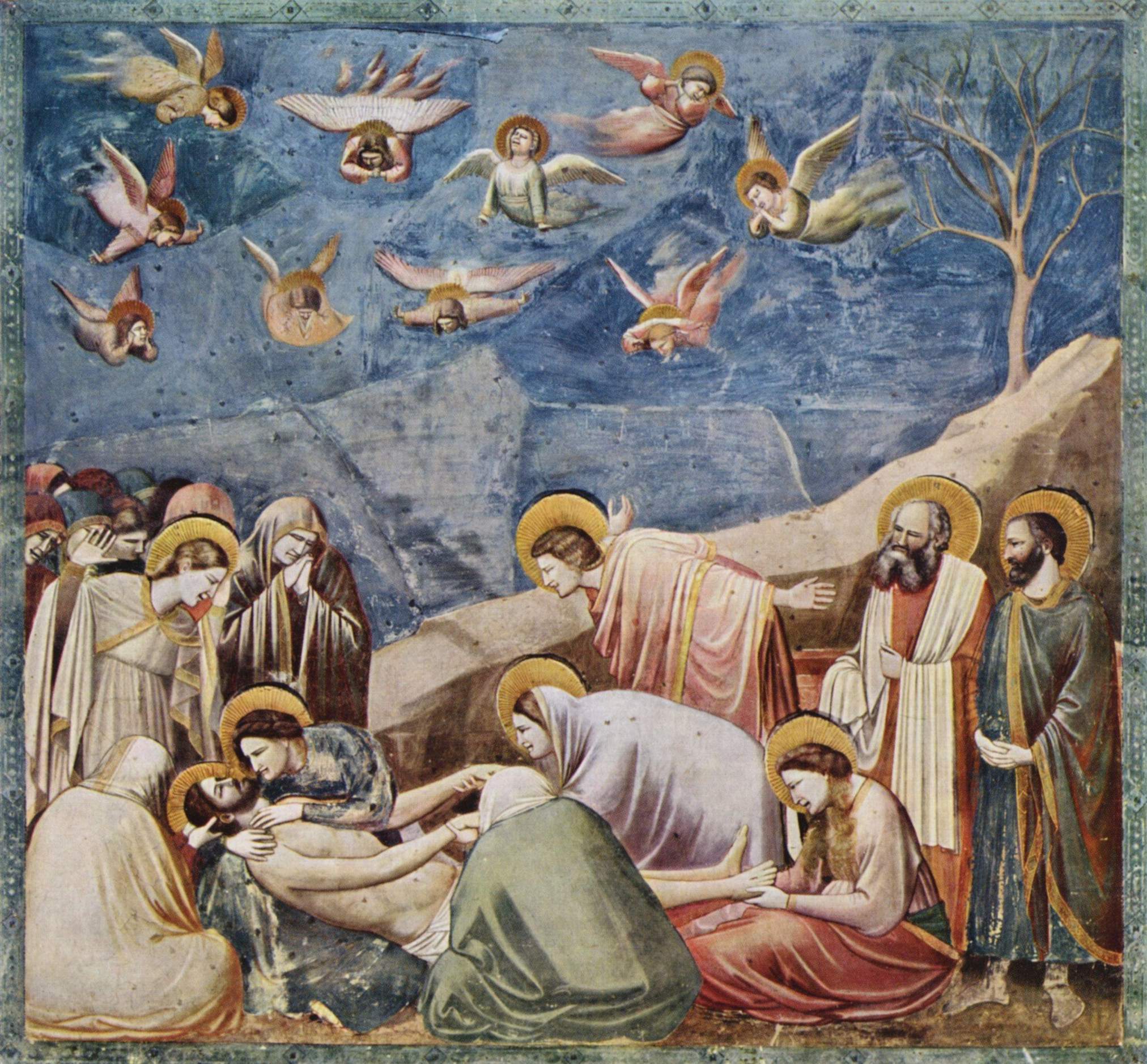 About this artwork →
Church life
- From 1309 the popes lived in Avignon, in France, instead of Rome. Clement V chose the town in 1309, and seven French popes in a row ruled from there. Critics called this the “Babylonian captivity” of the papacy. Gregory XI left Avignon in 1376 and reached Rome in January 1377. P: Catherine of Siena, Letter 74, “To Pope Gregory XI, in Avignon” V1: Catholic Encyclopedia, Catherine of Siena V2: Schaff VI, §§ on the Avignon exile.
- Catherine of Siena (1347–1380), a lay Dominican woman, urged Pope Gregory XI to come back to Rome and to put good shepherds over the people. Her letter asks him to follow Christ, the shepherd who laid down his life for his sheep. Catherine was one of several voices who pressed him. Do not give her all the credit for his return. P: Letter 74 V1: Catholic Encyclopedia, Catherine of Siena V2: Schaff VI, §§ on the Avignon exile and Catherine.
- Gregory Palamas (about 1296–1359) was a monk of Mount Athos. He defended hesychasm. This is a monks’ way of silent prayer that repeats the Jesus Prayer: “Lord Jesus Christ, Son of God, have mercy on me, a sinner.” He rested his defense on Christ. He wrote that the Son of God joined our nature to himself and gives himself to believers in the Lord’s Supper. P: Palamas, Triads I.3.38 (Eucharist), I.3.21–22 and II.3.9 V1: OCA, Saint Gregory Palamas V2: Encyclopaedia Britannica (1911), Palamas. The biographies do not check the detailed argument of I.3.38.
- Late fourteenth century: followers of John Wyclif (the Lollards) made the first full English Bible. They translated it from Latin. The oldest dated copy was made for Thomas of Woodstock, who died in 1397. We do not know who did the work, so it cannot be credited to Wyclif alone. Their Ephesians 2:8 reads “by grace ye ben sauyd bi feith … it is the yifte of God.” P: Middle English Ephesians 2:8–10, original-spelling sample V1: British Library, Egerton MS 618, Scope and Content V2: Bridwell Library, Wycliffite English Bible.
Controversy and heresy
- John Wyclif (died 31 December 1384) rejected transubstantiation. This is the teaching that the bread and wine turn wholly into Christ’s body and blood, so that only their look remains. Wyclif argued that the bread stays bread. This is a dispute about the Lord’s Supper. P: Wyclif, Trialogus, Communion excerpt V1: Catholic Encyclopedia, Wyclif V2: Schaff VI, §41, Eucharistic teaching. Do not assume his own teaching on the Supper matches the Lutheran confession.
- The hesychast controversy: the monk Barlaam, trained in Western scholastic thought, mocked hesychast prayer. Palamas answered that God’s own being (his “essence”) cannot be known or shared. But believers can share in his uncreated “energies,” the light that the apostles saw on the Mount of Transfiguration. This is a dispute about how sinners meet the God-man Christ. P: Palamas, Triads II.3.9 V1: OCA, Saint Gregory Palamas V2: Encyclopaedia Britannica (1911), Palamas.
- Unam Sanctam (18 November 1302): Pope Boniface VIII stated that every human being must be subject to the pope to be saved. It came in his quarrel with King Philip IV of France. The bull ties salvation to obedience to the pope instead of to Christ alone. P: Unam Sanctam, 1302 V1: Catholic Encyclopedia, Boniface VIII V2: Schaff VI, §§ on Boniface VIII and Philip IV.
- The Western Schism (1378): after Gregory XI died, the cardinals elected Urban VI in April 1378. Some of them then declared the vote invalid, saying a Roman mob had forced it. In September they elected Clement VII, who ruled from Avignon. For decades two popes, and later three, each claimed to be Christ’s true vicar. P: Manifesto of the Revolting Cardinals, 1378 V1: Catholic Encyclopedia, Western Schism V2: Schaff VI, §§ on the Great Western Schism.
- Teaching question: Compare the hesychast dispute with the Lutheran teaching that God gives certainty through his outward Word and the sacraments. State the Orthodox claim fairly and do not repeat its opponents’ caricatures. P: Palamas, Triads selections P: Large Catechism, Holy Baptism P: Large Catechism, Sacrament of the Altar, V: OCA, Palamas.
Councils and major events
- The Council of Vienne (1311–1312) was called by Clement V. Rome counts it as the 15th ecumenical (worldwide) council. Its first and greatest concern was the Knights Templar, a military order of monks. Clement closed the order by his own papal order, not by a court verdict that the order was guilty. P: Vox in excelso, suppression clause V1: Catholic Encyclopedia, Vienne V2: Schaff VI, §6, suppression paragraph and note 105.
- Lutheran classification: Mixed. The Lutheran Confessions accept two of its teachings. Christ has a true human body and soul. Baptism gives grace to infants. They reject the papal claim to rule the whole Church that gives the council its authority. This is the curriculum’s confessional judgment. Augsburg Confession III, Augsburg Confession IX, Smalcald Articles II IV.
- Vienne taught that the rational (thinking) soul is by its own nature the “form” of the human body. It means the soul is what makes the body a living human body. Anyone who stubbornly denied this was to be called a heretic. The decree opens by confessing that the Son took on a complete human nature. It was aimed at the teaching of Peter John Olivi, a Franciscan. P: Fidei catholicae fundamento, opening and soul clauses V1: Catholic Encyclopedia, Olivi, three disputed points V2: Catholic Encyclopedia, Soul, Scholastic teaching and Vienne.
- Vienne chose the view that Baptism gives grace and the Christian virtues to babies as well as adults. It based this on the power of Christ’s death, which is given in the same way to all who are baptized. P: Fidei catholicae fundamento, final baptism paragraphs V1: Catholic Encyclopedia, Sanctifying Grace, infants and Clement V V2: Vatican, Pastoralis actio, §7 and note 12. The 1980 instruction is a later Roman Catholic reading of the decree, not a second medieval source.
- The Palamite councils at Constantinople (1341, 1347 and 1351) upheld Palamas and made his teaching on God’s essence and energies official Orthodox doctrine. Orthodox writers treat them as a regional synod with the weight of an ecumenical council. P: Palamas, Triads selections V1: OCA, Saint Gregory Palamas V2: Encyclopaedia Britannica (1911), Palamas. The council acts themselves were not read here. The sources describe them.
- Lutheran classification: Not classified. The Lutheran Confessions never mention the distinction between God’s essence and his energies. They test every teaching by Scripture alone, so the curriculum leaves this synod unclassified. This is the curriculum’s confessional judgment. Formula of Concord, Rule and Norm, Formula of Concord, Person of Christ.
- The Earthquake Synod (London, 1382): Archbishop William Courtenay led a church court at Blackfriars that condemned 24 statements taken from Wyclif. Ten were called heresy and fourteen were called error. One was Wyclif’s denial that Christ is bodily present in the Lord’s Supper. Another was his claim that a priest in mortal sin cannot baptize or consecrate. An earthquake shook London during the meetings. The synod met in the spring. P: Gee and Hardy, Documents Illustrative of English Church History, no. XXXVII, Wycliffe propositions condemned at London, 1382 V1: Schaff VI, §§ on Wyclif and the Earthquake synod V2: Catholic Encyclopedia, Wyclif.
- Lutheran classification: Mixed. The Confessions agree that Christ is truly present in the Supper. An unworthy man does not spoil a sacrament that he gives. They disagree with the synod’s ban on the teaching that bread stays bread, which the Smalcald Articles affirm. They also reject its papal base. This is the curriculum’s confessional judgment. Augsburg Confession VIII, Smalcald Articles III VI, Formula of Concord VII.
Major people
- Catherine of Siena: read her letter to Gregory XI as the plea of a reformer who stayed loyal to the papacy. Compare the standards she uses to rebuke clergy with Christ the shepherd in John 10. P: Letter 74 V1: Catholic Encyclopedia, Catherine of Siena V2: Schaff VI, §§ on Catherine.
- John Wyclif (about 1324–1384), an Oxford teacher, attacked church wealth and transubstantiation. Use his text to separate his criticism of transubstantiation from the later Lutheran doctrine of Christ’s presence in the Supper. P: Trialogus excerpt V1: Catholic Encyclopedia, Wyclif V2: Schaff VI, §41.
- Gregory Palamas: read his defense before you decide what he says about the body, prayer, and communion with God. He grounds his argument in the Incarnation and the Lord’s Supper. P: Triads selections V1: OCA, Palamas V2: Encyclopaedia Britannica (1911), Palamas.
- Dante Alighieri wrote the Divine Comedy about 1308–1320. It describes an imagined journey through Hell, Purgatory, and Paradise. Read it beside the doctrine of salvation. In the last canto he sees a human likeness in the circle of divine light, a sign of the Son’s humanity. P: Dante, Comedy, Inferno, Purgatorio and Paradiso V1: Princeton Dante Project, Commedia introduction V2: Princeton Alumni Weekly, Translating heaven, Dates: Oxford course handbook, printed p. 45, PDF p. 48.
Wider world
- 1324: Mansa Musa, the ruler of Mali in West Africa, passed through Cairo on his pilgrimage to Mecca. He gave away so much gold that, writers said, the price of gold fell in Egypt. Some sources date the trip 1324–1325. P: Al-Umari’s account of Mansa Musa in Cairo V1: Boston University African Studies, Kingdom of Mali V2: World History Encyclopedia, Mansa Musa I.
- 1337: The Hundred Years’ War between England and France began and lasted until 1453. Edward III of England claimed the French throne. The English won a famous victory at Crécy in 1346. P: Froissart, On the Hundred Years War V1: Encyclopaedia Britannica (1911), Hundred Years’ War V2: World History Encyclopedia, Hundred Years’ War.
- 1348: The Black Death struck Florence. P: Boccaccio, Decameron: Introduction, opening date V1: Brown University, collective death in the Decameron V2: Treccani, Firenze: L’età comunale.
- 1381: The Peasants’ Revolt broke out in England. Its leaders included Wat Tyler. The rebels wanted an end to the poll tax and to serfdom. P: Anonimalle Chronicle, revolt account V1: World History Encyclopedia, Peasants’ Revolt V2: E. B. Fryde, Historical Association, opening public excerpt.
Confessional Lutheran connection
- Lutheran teaching prompt, Christology: Use Vienne’s statement about Christ’s soul and body to review his complete humanity and the unity of his person. The Augsburg Confession says Christ is one person, true God and true man. P: Vienne, doctrinal decree P: Augsburg Confession III P: Formula of Concord VIII.
- Lutheran teaching prompt, Baptism: Compare Vienne with the confession that Baptism gives grace and that children are to be baptized. P: Vienne, doctrinal decree P: Augsburg Confession IX P: Large Catechism IV.
- Lutheran teaching prompt, Lord’s Supper: Compare Wyclif and Palamas with the Lutheran confession of Christ’s body and blood. The Smalcald Articles say the bread remains bread, and Christ’s body is truly given with it. Ask how Christ gives assurance during illness, death, and fights over church authority. P: Wyclif, Trialogus excerpt P: Smalcald Articles III VI P: Formula of Concord VII P: Large Catechism V.
- Lutheran teaching prompt, papal claims: Compare Unam Sanctam with the Smalcald Articles, which say that Christians do not need the pope to be saved. Ask what the two-pope Western Schism shows about trusting a human office for certainty. This is the curriculum’s confessional judgment. P: Unam Sanctam P: Smalcald Articles II IV P: Treatise on the Power and Primacy of the Pope.
- Source exercise: Compare Boccaccio’s words about the dead with modern estimates. Do not repeat his total as a count of deaths. The other Wider world items have no direct tie to Christ’s person or the sacraments in these sources. Mansa Musa, the Hundred Years’ War, and the Peasants’ Revolt are examples. Treat the plague as a question: where do Baptism and the Supper comfort the dying? P: Decameron, Introduction V1: Encyclopaedia Britannica (1911), Florence V2: Treccani, section on 1348.
- Lutheran teaching prompt, Scripture and salvation: Compare the Wycliffite Ephesians passage and Dante’s picture of purification with Christ’s saving work. Ask where Baptism and the Supper give assurance. P: Wycliffite Ephesians 2:8–10 P: Dante, Purgatorio I, Lutheran norm: Augsburg Confession IV, Augsburg Confession IX, Augsburg Confession X, Augsburg Confession XXIV.