Week 4 · 4th century: AD 301–400
Artwork
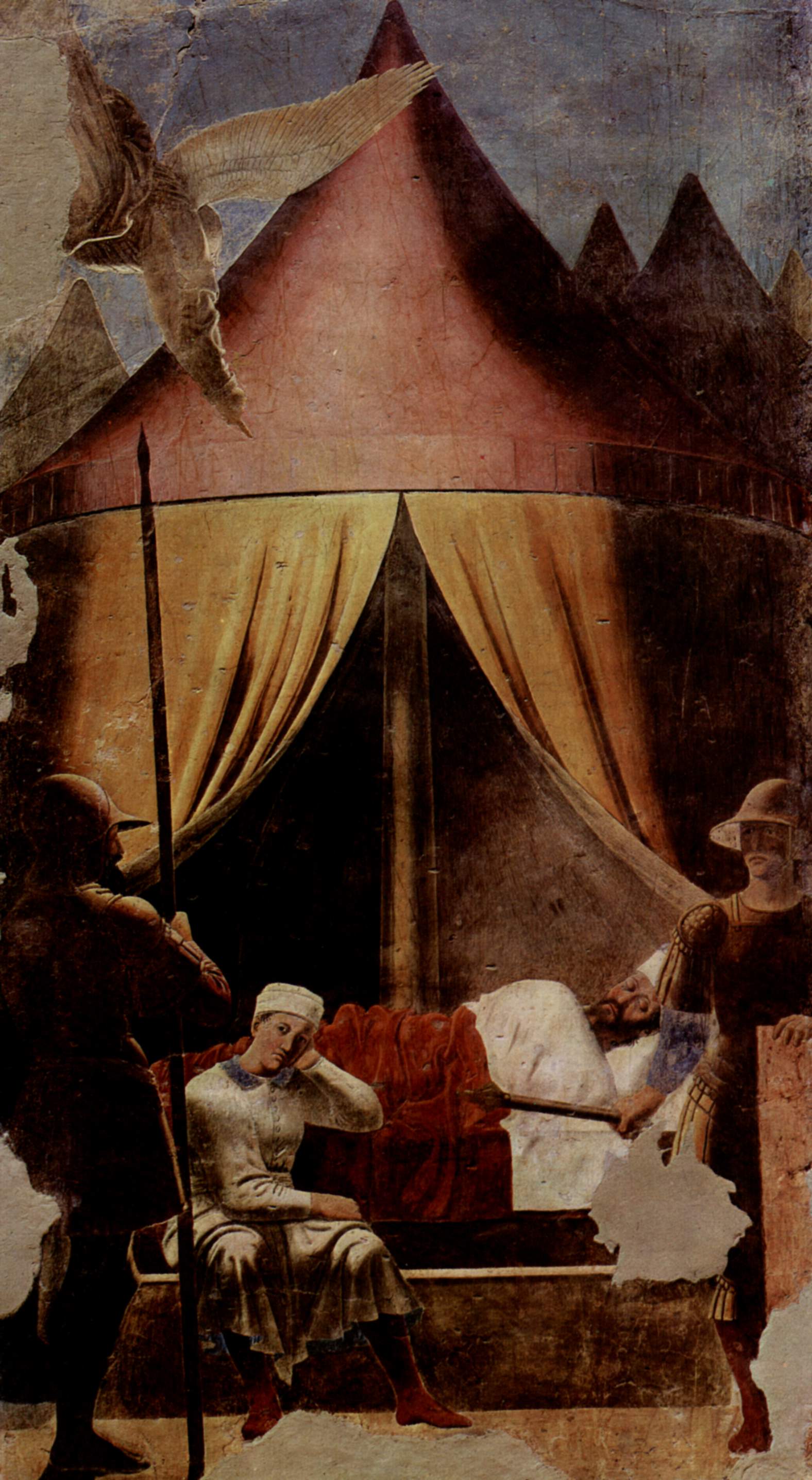
- Title: The Dream of Constantine (also called The Vision of Constantine)
- Artist: Piero della Francesca
- Date made: about 1452 to 1466. This is about 1,100 years after the event it shows (AD 312).
- Medium: Fresco (paint on wet plaster)
- Current location: Basilica of San Francesco, Arezzo, Italy, in the “Legend of the True Cross” cycle
- Source page
- License: public domain. The Commons file page records the painting and this photograph as public domain.

What you see
A scene of dark and first light. Emperor Constantine sleeps on a bed inside a large tent. A servant sits in front of him with his head on his hand. Two guards stand watch, one on each side. Above the tent, an angel dives down from the dark sky. The angel holds out a small cross toward the sleeping emperor, and the angel’s light falls on the tent.
Why it matters
The fresco is one panel in a large cycle that tells the story of the wood of Christ’s cross. A family named Bacci paid for the cycle, and Piero painted it in the 1450s and 1460s. The cycle draws on a thirteenth-century book of saints’ lives, the Golden Legend. The panel shows Constantine’s dream before his battle at the Milvian Bridge in AD 312. Ancient writers tell the story in two ways. Eusebius reports a cross of light in the sky at midday. Lactantius reports a dream on the night before the battle. Piero follows the dream version. Older writers called his scene a night, but the Web Gallery of Art says the restored fresco shows dawn.
Christ and the sacraments
The cross is the sign of Christ’s saving work. The story says Constantine won the empire under that sign. In AD 325, Constantine called the Council of Nicaea. That council confessed that the Son is true God. The picture does not show Baptism or the Lord’s Supper. It points instead to Christology (the teaching about Christ’s person and work), because the cross stands for what the Son of God did for sinners.
Teaching question
Constantine linked his power to the sign of Christ’s cross. What does Augsburg Confession III say Christ’s cross did for sinners?
Passage to read: Augsburg Confession III, the article on the Son of God.
Sources
- Cycle, dates, patron, and the Golden Legend source: Web Gallery of Art, View of the Cappella Maggiore, which names the Bacci family as patrons, Bicci di Lorenzo’s death in 1452, and the dates 1452–66. See also Web Gallery of Art, Legend of the True Cross.
- The scene itself: Web Gallery of Art, Vision of Constantine, a fresco in San Francesco, Arezzo, dated 1452–66, with the tent, the angel with a cross of light, the servant, and the two sentries.
- Ancient report of a cross of light: Eusebius, Life of Constantine I.28–31, a daytime vision.
- Ancient report of a dream: Lactantius, Deaths of the Persecutors 44, a night dream.