Week 1 · Early
1st centuryAD 1–100
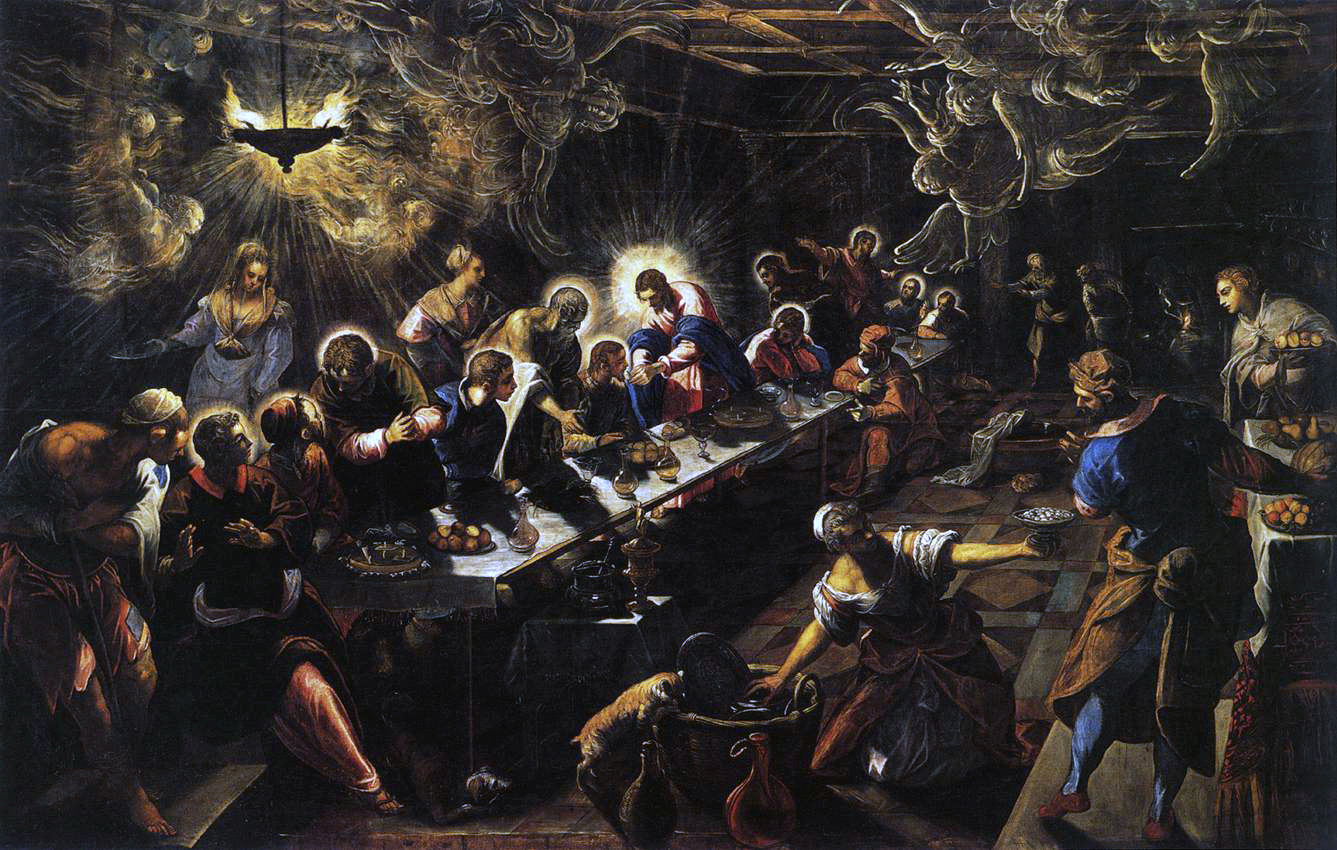 About this artwork →
Church life
- The church began with one message: Jesus Christ, the Son of God, died for our sins and rose on the third day. Paul says he passed on this message as the most important thing he had received, and he lists the witnesses who saw the risen Christ. The Roman historian Tacitus agrees that Christ was put to death under Pontius Pilate. P: 1 Corinthians 15:3–8 V1: Tacitus, Annals 15.44, Christ executed under Pilate V2: Chrysostom, First Corinthians Homily 38, exposition of 15:3–8.
- On Pentecost, the Holy Spirit came on the apostles in Jerusalem. Jews from many lands heard the Gospel in their own languages, and Peter preached Christ to them. Pentecost was the Jewish harvest festival, and the crowd had come to Jerusalem for it. P: Acts 2:1–13 V1: Chrysostom, Acts Homily 4, exposition of Acts 2:1–13 V2: Catholic Encyclopedia, Pentecost (Jewish Feast), pilgrim crowds in Jerusalem.
- Acts says Peter called his hearers to repent and be baptized in Jesus’ name for the forgiveness of sins. About 3,000 people were baptized that day. P: Acts 2:37–42 V1: Chrysostom, Acts Homily 7, exposition of Acts 2:38–42 V2: Cyril of Jerusalem, Catechetical Lecture 3.15, explicit quotation of Peter’s instruction.
- Jesus told the apostles to make disciples of all nations. They were to baptize in the name of the Father, the Son, and the Holy Spirit. The Didache (an early guide to church practice) uses the same words for Baptism. P: Matthew 28:18–20 V1: Chrysostom, Matthew Homily 90, exposition of Matthew 28:16–20 V2: Catholic Encyclopedia, The Didache, instruction on Baptism.
- On the night he was betrayed, Jesus gave his disciples bread and wine. He said, “This is my body” and “This is my blood … for the forgiveness of sins.” P: Matthew 26:26–28 V1: Chrysostom, Matthew Homily 82, exposition of Matthew 26:26–28 V2: Cyril of Jerusalem, Catechetical Lecture 22, the Body and Blood of Christ.
- Paul rebuked the Corinthians for divisions at the Lord’s Supper. He warned that anyone who eats and drinks unworthily is guilty concerning the body and blood of the Lord. P: 1 Corinthians 11:17–34 V1: Chrysostom, First Corinthians Homily 27 V2: Catholic Encyclopedia, Corinthians, divisions of the first epistle.
- Paul taught that sinners are made right with God as a gift, through faith in Jesus Christ, and not by works of the law. P: Romans 3:21–28 V1: Chrysostom, Romans Homily 7, exposition of Romans 3:21–28 V2: Augustine, On the Spirit and the Letter, comment on Romans 3:21–22.
- At Antioch in Syria, the disciples were first called “Christians.” Barnabas and Paul taught there for a whole year. P: Acts 11:19–26 V1: Chrysostom, Acts Homily 25, exposition of Acts 11:19–26 V2: Catholic Encyclopedia, Church of Antioch, the name “Christians”.
- The four Gospels (Matthew, Mark, Luke, and John) record the life, death, and resurrection of Christ. The church of the second century already said that the four were written by apostles or their companions, and that John wrote last at Ephesus. P: Irenaeus, Against Heresies 3.1.1 V1: Eusebius, Church History 3.24, order of the Gospels V2: Luke 1:1–4, Luke’s own statement of purpose.
- The Didache gives early directions for Baptism, fasting, the Lord’s Supper, and church leaders. Scholars disagree on its date. The Catholic Encyclopedia places it in the first century or soon after. P: Didache 7–10 V1: Eusebius, Church History 3.25, the “Teachings of the Apostles” V2: Catholic Encyclopedia, The Didache, date and contents.
Controversy and heresy
- The first big dispute asked whether Gentile believers had to be circumcised and keep the law of Moses (Acts 15:1–5). At stake was whether Christ alone saves. Peter said both Jews and Gentiles “will be saved through the grace of the Lord Jesus” (Acts 15:11). P: Acts 15:1–11 V1: Zondervan Encyclopedia, Council of Jerusalem, occasion and issue V2: Chrysostom, Acts Homily 33.
- Some teachers denied that Christ truly came in the flesh. John says that anyone who denies this does not come from God. Irenaeus says John wrote his Gospel to refute Cerinthus, a teacher who separated the man Jesus from the divine Christ. P: 1 John 4:2–3 V1: Irenaeus, Against Heresies 3.11.1, John against Cerinthus V2: Catholic Encyclopedia, Cerinthus.
Councils and major events
- Jerusalem apostolic assembly, about AD 48–51: The apostles and elders agreed that Gentiles need not be circumcised, because they are saved by grace. The letter also asked Gentile believers to avoid certain food and sexual immorality. P: Acts 15:6–29 V1: Zondervan Encyclopedia, Council of Jerusalem, council’s occasion and judgment V2: Chrysostom, Acts Homily 33. Acts gives no calendar year. Zondervan says AD 48 or 49. The Catholic Encyclopedia, Judaizers says AD 50 or 51.
- Stephen, one of the first seven deacons, was stoned in Jerusalem after he preached about Christ. He is the first Christian martyr (martyr means a witness who dies for the faith). His death set off a wider persecution that scattered believers, and they spread the Gospel. P: Acts 6:8–7:60 V1: Chrysostom, Acts Homily 15, on Stephen V2: Eusebius, Church History 2.1, Stephen’s martyrdom and the scattering.
- In AD 64, a great fire burned much of Rome. Rumor blamed Emperor Nero. He blamed the Christians. Many were killed, and tradition says Peter and Paul died in this persecution. P: Tacitus, Annals 15.44 V1: Suetonius, Nero 16, punishment of Christians V2: Eusebius, Church History 2.25, Peter and Paul under Nero. The year of the apostles’ deaths is not certain. The Catholic Encyclopedia, Nero says AD 67.
- In the late first century, the church in Rome sent Corinth a letter against internal division. The work is traditionally called First Clement. It also says that Peter and Paul suffered martyrdom. P: First Clement 1, 5, 44, 47, 54 V1: Catholic Encyclopedia, Clement I, epistle V2: Benedict XVI, Clement, 7 March 2007.
- Jesus had foretold the fall of Jerusalem. Roman forces destroyed the city and its Temple in AD 70. Eusebius says the Christians of Jerusalem had already left for Pella, east of the Jordan. P: Josephus, Jewish War VI.4, especially VI.4.5–8 V1: Catholic Encyclopedia, Jerusalem after AD 70, Titus and the flight to Pella V2: Eusebius, Church History 3.5, flight to Pella. Jesus’ warning is in Luke 21:20–24. A further study of Josephus’ account is University of Salamanca, The God away from his city.
- Near the end of Domitian’s reign, John was on the island of Patmos, where he received the vision recorded in Revelation. John testified there about Jesus Christ. P: Revelation 1:9 V1: Irenaeus, Against Heresies 5.30.3, vision “towards the end of Domitian’s reign” V2: Eusebius, Church History 3.18, John on Patmos.
Major people
- Jesus Christ is the center of the century. He was born of the virgin Mary, baptized by John, crucified under Pilate, and raised from the dead. Matthew and Luke record his birth. All four Gospels record his death and resurrection. P: Luke 1:26–38 and 24:1–7 V1: Irenaeus, Against Heresies 3.21, Christ born of a virgin V2: Tacitus, Annals 15.44.
- Mary is the mother of Jesus. The angel told her that she will bear the Son of God. Chrysostom reads Matthew’s account as showing a birth that is not by the usual course of nature. P: Luke 1:26–38 V1: Chrysostom, Matthew Homily 4, on Matthew 1:18–25 V2: Irenaeus, Against Heresies 3.21.
- John the Baptist preached repentance, baptized Jesus, and prepared the way for him. Herod had him beheaded. P: Luke 3:1–22 V1: Chrysostom, Matthew Homily 10, on Matthew 3 V2: Eusebius, Church History 1.11, John’s death, with Josephus.
- Peter was the first apostle to confess Jesus as “the Christ, the Son of the living God.” He preached at Pentecost and in Jerusalem. He also led the first Gentile conversion, that of the Roman officer Cornelius. He spoke in the Jerusalem assembly (Acts 15:7–11). P: Matthew 16:13–20 P: Acts 10:34–48 V1: Chrysostom, Matthew Homily 54, on Peter’s confession V2: Catholic Encyclopedia, Peter, confession and Pentecost.
- Paul first persecuted the church. The risen Christ then met him near Damascus. Christ said, “I am Jesus, whom you are persecuting.” Paul became the apostle to the Gentiles (Romans 11:13). He wrote letters to many churches. P: Acts 9:1–19 P: Romans 11:13 V1: Chrysostom, Acts Homily 19, Paul’s conversion V2: Benedict XVI, Paul, 25 October 2006.
- James, the Lord’s brother, led the Jerusalem church. He gave the judgment at the Jerusalem assembly. P: Acts 15:13–21 V1: Zondervan Encyclopedia, Council of Jerusalem, judgment V2: Chrysostom, Acts Homily 33.
- John the apostle wrote the Gospel and letters that bear his name and Revelation. Irenaeus says he lived at Ephesus until the time of Trajan (emperor from AD 98). P: Revelation 1:9 V1: Irenaeus, Against Heresies 3.3.4, John at Ephesus V2: Eusebius, Church History 3.23, John until Trajan.
- Mark and Luke wrote Gospels. Mark was Peter’s interpreter, and Luke was Paul’s companion. P: 1 Peter 5:13 and Colossians 4:14 V1: Irenaeus, Against Heresies 3.1.1 V2: Eusebius, Church History 3.39, Papias on Mark.
- Clement of Rome wrote the church’s letter to Corinth. Irenaeus names him the third bishop of Rome after the apostles. P: First Clement 1 and 44 V1: Irenaeus, Against Heresies 3.3.3, Clement in the Roman succession V2: Catholic Encyclopedia, Clement I.
Wider world
- Jesus was born under Caesar Augustus, and he was crucified under Pontius Pilate in the reign of Tiberius (AD 14–37). Roman rule shaped the world of the apostles. P: Luke 2:1 and 3:1–2 V1: Catholic Encyclopedia, Augustus, reign in which Christ was born V2: Catholic Encyclopedia, Tiberius, reign dates. Tacitus also says Pilate executed Christ under Tiberius: Tacitus, Annals 15.44.
- In AD 64, a fire burned much of Rome. Nero rebuilt the city with wider streets and stone fronts. P: Tacitus, Annals 15.38–43 V1: Suetonius, Nero 38 and 43, fire and rebuilding V2: Catholic Encyclopedia, Nero, fire and rebuilding of Rome.
- In AD 79, Vesuvius erupted and buried Pompeii. P: Pliny the Younger, Letters 6.16 and 6.20, eruption account P: Suetonius, Titus 8.3–4, buried cities V1: Pompeii Archaeological Park, Pompeii after the Eruption, opening V2: Italian Civil Protection Department, Eruptive history, AD 79 eruption.
- In AD 80, Titus opened Rome’s Colosseum with public games. P: Suetonius, Titus 7.3, amphitheatre dedication V1: Colosseum Archaeological Park, Blood and the Arena, opening V2: Mark Cartwright, Colosseum, construction and timeline. The Colosseum park dates the opening games to June through September of AD 80.
Confessional Lutheran connection
- Teaching prompt, Christology: Explain who suffers and rises in the apostolic proclamation. Read Acts 2:22–36 alongside Augsburg Confession III.1–6. Peter confessed Christ in Matthew 16. Paul taught justification in Romans 3. Both match the Confession: Christ is true God and true man, and he died to reconcile us to the Father. Compare Augsburg Confession IV with Romans 3:21–28 and Solid Declaration III.
- Teaching prompt, the Person of Christ: John warns against those who deny that Christ came in the flesh (1 John 4:2–3). Compare this with Solid Declaration VIII. It confesses one Christ, true God and true man.
- Teaching prompt, Baptism: Connect the forgiveness promised in Baptism with the saving work of Christ. Compare Acts 2:38–39 and Matthew 28:19 with Augsburg Confession IX.1–3 and Small Catechism, Baptism.
- Teaching prompt, Lord’s Supper: Explain the body and blood given in the Supper. Compare 1 Corinthians 11:23–29 and Matthew 26:26–28. Then read Augsburg Confession X.1–2, Solid Declaration VII, and Small Catechism, the Sacrament of the Altar.
- Confessional judgment of the curriculum: The Acts 15 assembly is Scripture, not a later council, so it is not graded. Its verdict is that Gentiles are saved “through the grace of the Lord Jesus.” This fits Augsburg Confession IV. Augsburg Confession VII adds that the church is held together by the Gospel and the Sacraments.
- Limit: The Wider world items (Pompeii, the Colosseum, and the fire of Rome) have no direct tie to Christ or the sacraments. Only the Roman rule item and the destruction of Jerusalem connect to Christ’s life and words.