Week 21 · Modern
21st centuryAD 2001–October 5, 2026 (ongoing)
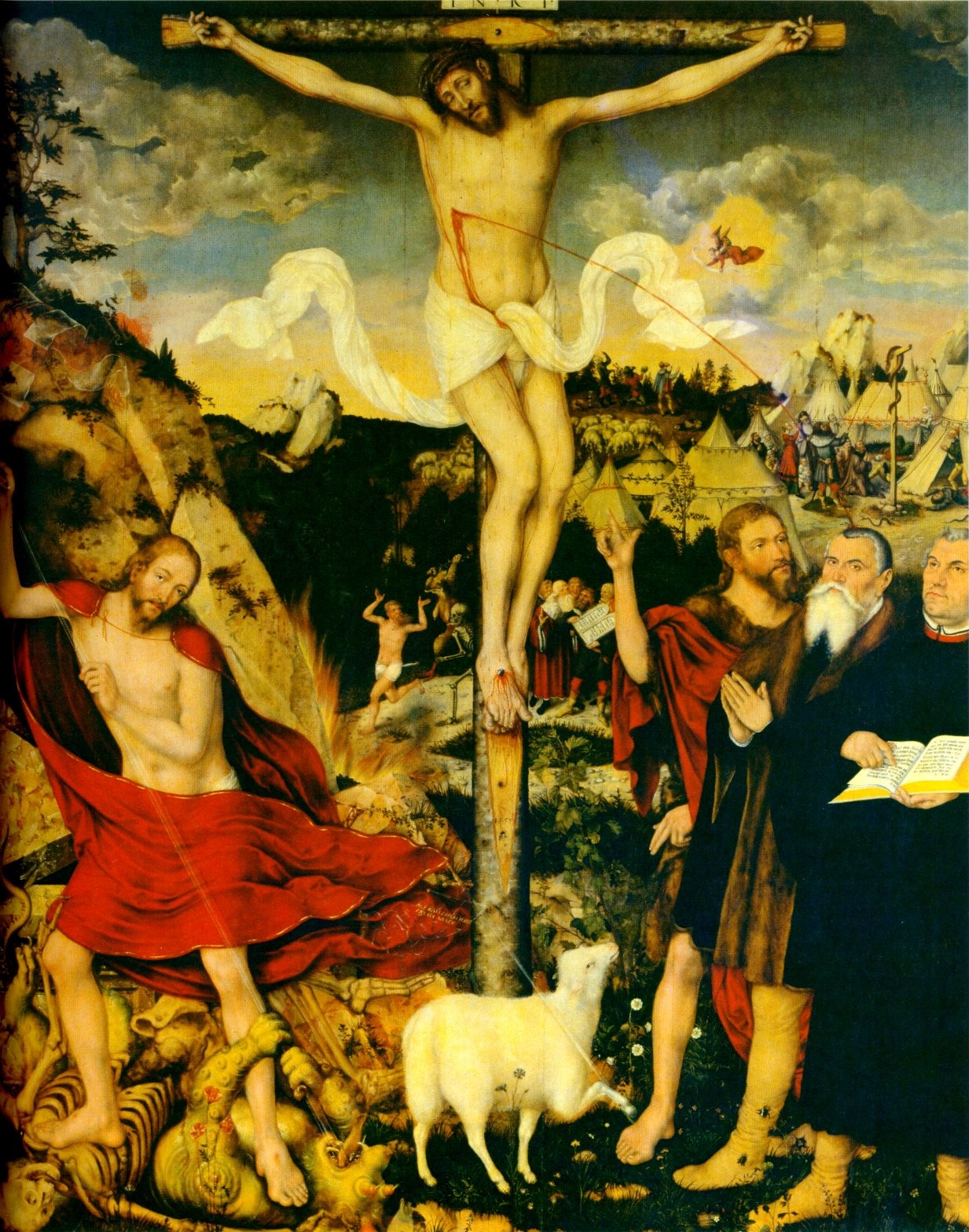 About this artwork →
This unit stops on October 5, 2026. North America is the main focus. Each Lutheran body speaks only for itself, so read its own documents. Do not treat one body’s policy as the policy of all Lutherans.
Church life
- The Lutheran Church—Missouri Synod (LCMS) says the Bible is its only rule for teaching. It accepts every writing in the Book of Concord (the 1580 collection of Lutheran confessions). It does so “because” each one agrees with Scripture, not just “in so far as” it does. It also teaches that God gives the forgiveness Christ won through the Word, Baptism, and the Lord’s Supper. This is the Synod’s stated position, not a claim about every member. P: LCMS, Brief Statement (1932), “Of the Symbols” and “Of the Means of Grace” V1: LCMS, Lutheran Confessions page V2: LCMS, Statement of Scriptural and Confessional Principles (1973).
- The Evangelical Lutheran Church in America (ELCA) confesses Jesus Christ as “Lord and Savior” and as the Word of God made flesh. Its constitution accepts the Unaltered Augsburg Confession as “a true witness to the Gospel” (section 2.05). That Confession is the 1530 statement of Lutheran faith. The constitution calls the other Book of Concord writings “further valid interpretations of the faith of the Church” (section 2.06). It does not use the “because” wording of the LCMS, WELS, and ELS. P: ELCA Constitution, chapter 2, sections 2.01 to 2.06 V1: ELCA Model Constitution for Congregations, C2.05 and C2.06, in the same volume V2: ELCA, What Lutherans Believe.
- The Wisconsin Evangelical Lutheran Synod (WELS) says the Bible is the final authority and is “without error” in what it teaches. WELS “wholeheartedly” subscribes to the Lutheran Confessions in the 1580 Book of Concord. It holds them to be a correct explanation of biblical truth. It teaches the “real and substantial presence of Christ’s body and blood” in the Lord’s Supper, as its statement says. P: WELS, Doctrinal Statements V1: WELS, This We Believe V2: WELS, Doctrinal Statement on the Lord’s Supper.
- The Evangelical Lutheran Synod (ELS) accepts the Book of Concord “not in so far as but because” it agrees with Scripture. It teaches that Christ’s “body and blood are truly present, distributed and received” in the Lord’s Supper for the forgiveness of sins. It says the Supper is for Christians who know and hold the teachings of God’s Word and can examine themselves. P: ELS, We Believe, Teach, and Confess V1: ELS, Doctrinal Statements V2: ELS, Answers on Closed Communion.
- In 2006 the LCMS published Lutheran Service Book, a new hymnal. Its publishers mailed details of eight editions in spring 2006, for sale that fall. The Synod reported in 2016 that 85 percent of its congregations used it, and The Lutheran Witness said in 2026 that more than 90 percent do. P: LCMS News, 2006, “Mailings detail Lutheran Service Book” V1: LCMS Reporter, “10 years of Lutheran Service Book,” 28 November 2016 V2: The Lutheran Witness, “Reflections on Hymn Singing and 20 Years of Lutheran Service Book,” 2026.
- In 2006 the ELCA and the Evangelical Lutheran Church in Canada began to use Evangelical Lutheran Worship. It replaced the 1978 Lutheran Book of Worship. The new book became available on 3 October 2006. P: ELCA News Service, September 2006, new worship book available 3 October V1: ELCA News Service, 19 October 2006, orders for the new worship book V2: Pray Tell, “A New ELCA Worship Book,” 2010.
- Fewer Americans belong to a church. Gallup found that 47 percent of U.S. adults belonged to a church, synagogue, or mosque in 2020. This was the first time in Gallup’s eight-decade survey that the figure fell below 50 percent. P: Gallup, “U.S. Church Membership Falls Below Majority for First Time,” March 2021 V1: Pew Research Center, 2023–24 study, executive summary, 26 February 2025 V2: Pew Research Center, “U.S. Public Becoming Less Religious,” 3 November 2015.
- The fall in religious belonging appears to be slowing. Pew’s 2023–24 study found that 62 percent of U.S. adults call themselves Christian. Of these, 40 percent are Protestant, 19 percent are Catholic, and 3 percent are other Christians. Pew describes the share as stable since 2019. P: Pew Research Center, 2023–24 study, executive summary, 26 February 2025 V1: Pew Research Center, “U.S. Public Becoming Less Religious,” 3 November 2015 V2: Gallup, “U.S. Church Membership Falls Below Majority for First Time,” March 2021.
- The Catholic Church in the United States faced a public crisis over priests who abused children. On 6 January 2002 the Boston Globe’s Spotlight team reported how the Archdiocese of Boston handled one such priest, John Geoghan. In June 2002 the U.S. bishops met in Dallas. They adopted the Charter for the Protection of Children and Young People by 239 to 13. It bars from ministry any priest or deacon who abuses a minor even once. P: USCCB, The Dallas Charter V1: America, “U.S. Bishops Rule Zero Tolerance for Priests Who Abuse,” 1 July 2002 V2: Boston Globe, Spotlight Investigation, about this site.
- Teaching prompt: compare each body’s own documents in a table. Use P: ELCA constitution, chapter 2 P: LCMS, Doctrine P: WELS, This We Believe, and P: ELS, We Believe, Teach, and Confess. Make rows for Christology, Baptism, the Supper, biblical authority, ministry, and fellowship.
- Teaching prompt: compare a local congregation’s stated confession with its teaching and practice of the sacraments. Use P: Augsburg Confession VII, IX and X, XIII and P: Small Catechism.
Controversy and heresy
- On 23 September 2001, twelve days after 9/11, David Benke prayed at the “A Prayer for America” rally. He was president of the LCMS Atlantic District (a regional group of congregations). The rally at Yankee Stadium in New York included Christian and non-Christian clergy, political leaders, and entertainers. Pastors and congregations charged him with “unionism” and “syncretism” (worship that joins different faiths). A Synod vice-president suspended him on 25 June 2002. On 11 April 2003 a three-person dispute panel dismissed the charges. It cited a 2001 convention resolution on “once in a lifetime” civic events. That resolution allows pastors to join them with no limit on praying in Jesus’ name. Synod President Gerald Kieschnick later said the prayer needed “a stronger articulation of the truth of Holy Scripture” (July 2004). He tied this to “the absolute necessity of faith in Jesus Christ” as the only way to eternal life. P: LCMS News, 12 July 2002, “Kieschnick calls on Schulz to reverse Benke suspension” V1: Christianity Today, “Yankee Stadium Strike Out,” July 2003 V2: LCMS Reporter, Kieschnick’s convention report, July 2004.
- During the COVID-19 shutdowns, a few churches gave Communion by video. The LCMS argued over this practice. On 1 August 2023 delegates to its convention passed Resolution 5-08A, “To Affirm In-Person Communion,” by 842 to 140. They voted to “clearly and unequivocally reject and condemn the practice of virtual (online) Communion” in the Synod. The resolution says consecration (the blessing of the bread and wine), distribution, and reception belong together. The CTCR is the Synod’s Commission on Theology and Church Relations. Its separate study appears in the same workbook. P: Resolution 5-08A, reproduced in Appendix C of Proper Administration of the Lord’s Supper in the 2026 workbook, original citation 2023 Proceedings pp. 152–153 V1: Roy Askins, convention report, 1 August 2023 V2: CTCR, Proper Administration of the Lord’s Supper, footnote 24.
- Many Americans doubt that Christ is the only way to eternal life. Pew’s 2007 survey found that seven in ten Americans with a religion say many religions can lead to eternal life. Pew’s August 2008 follow-up found that 52 percent of Christians say at least some non-Christian faiths can. In 2014, two-thirds of Christians said many religions can lead to eternal life. This is a Christological question: who Christ is and whether salvation comes only through Him. P: Pew Research Center, 2007 survey report on religious beliefs and practices, June 2008 V1: Pew Research Center, “Many Americans Say Other Faiths Can Lead to Eternal Life,” 18 December 2008 V2: Pew Research Center, “U.S. Public Becoming Less Religious,” 3 November 2015.
- Teaching prompt: test arguments for remote consecration. Use P: Formula VII.83–87 and P: Small Catechism, Sacrament of the Altar. Ask what consecration, distribution, eating, and drinking each involve.
Councils and major events
- The ELCA and the Episcopal Church (the U.S. Anglican church) began “full communion” on 1 January 2001. The plan was called Called to Common Mission. The ELCA assembly approved it on 19 August 1999 by 716 to 317. The Episcopal Church approved it in July 2000. Full communion means each church recognizes the other’s members, ministries, and sacraments, and the two can exchange clergy. A bishop will regularly preside at the ordination of all ELCA clergy. ELCA bishops will join the “historic succession” (the unbroken chain of bishops back to the early church). The two churches held a celebration service on 6 January 2001 at Washington National Cathedral. P: ELCA, Commentary on Called to Common Mission, with the adopted text V1: Christianity Today, “Episcopalians and Lutherans Celebrate Full Communion,” January 2001 V2: ELCA News Service, 8 July 2000, “Episcopal Church Adopts Full Communion Agreement with ELCA”.
- In August 2009 the ELCA Churchwide Assembly (its top lawmaking body) met in Minneapolis. It voted 559 to 451 for a resolution on ministry policy. The resolution committed the ELCA to find a way for people in “publicly accountable, lifelong, monogamous, same-gender relationships” to serve as rostered leaders. Rostered leaders are pastors and other officially listed church workers. The assembly also voted 619 to 402 to find ways for willing congregations to recognize and support such relationships. The same assembly adopted the social statement Human Sexuality: Gift and Trust by a two-thirds vote. This describes the adopted policy. It does not make the policy a doctrinal standard for this curriculum. P: ELCA Churchwide Assembly, Legislative Update, CA09.05.22 to CA09.05.27, pp. 1–3 V1: Ted Olsen, Christianity Today, 21 August 2009 report and update V2: ELCA 2019 Memorials Committee report, background, pp. 48–49.
- The Orthodox churches held the Holy and Great Council in June 2016 at Kolymbari, on the island of Crete. Its Encyclical (a letter to all the churches) calls the Council “an authentic witness to faith in Christ, the God-man” for all people. The Council issued six texts, an Encyclical, and a Message. The patriarchates of Antioch, Moscow, Bulgaria, and Georgia stayed away at the last moment. In 2026 the Ecumenical Patriarch asked them to study the texts again and adopt them. P: Holy and Great Council, Encyclical, Crete 2016 V1: Orthodox Times, Ecumenical Patriarch’s reply on the tenth anniversary, 2026 V2: Ecumenical Patriarchate, press release, 17 June 2016, “Synaxis: primates acknowledge pain in absence of missing Churches”.
- Lutheran classification: Not classified. Crete settled no new doctrine about Christ. Its topics were mission, fasting, marriage, and relations with other Christians, which are mostly matters of church order. Its claim that the Orthodox Church alone is the one Church is a separate question. Augsburg Confession VII answers it. Augsburg Confession VII, “Of the Church”
- On 31 October 2016 Pope Francis and Bishop Munib Younan led a joint service in Lund Cathedral, Sweden. Younan was president of the Lutheran World Federation. The service began the 500th-anniversary year of the Reformation. Their joint statement says “our common faith in Jesus Christ and our baptism” call both churches to daily conversion. P: Joint Statement, Joint Catholic and Lutheran Commemoration of the Reformation, Lund, 31 October 2016 V1: Lutheran World Federation, Joint Ecumenical Commemoration of the Reformation V2: Holy See Press Office bulletin, 31 October 2016.
- On 28 November 2025 Pope Leo XIV and Ecumenical Patriarch Bartholomew I prayed at Iznik, the ancient Nicaea. They marked the 1,700th anniversary of the Council of Nicaea (AD 325). On 29 November they signed a joint declaration. The declaration calls the faith of Nicaea “the saving faith in the person of the Son of God,” in its own words. It says the Son is true God from true God. It uses the Greek word homoousios, which means “of one substance.” P: Joint Declaration of Pope Leo XIV and Ecumenical Patriarch Bartholomew, 29 November 2025 V1: Catholic News Agency, “Pope Leo XIV marks Nicaea anniversary,” 28 November 2025 V2: Exaudi, “Leo XIV and Bartholomew I sign joint declaration,” 29 November 2025.
- Lutheran classification: Received. Nicaea I (325) taught that the Son is truly God, of one substance with the Father. The Augsburg Confession calls the Nicene decree on the Trinity “true and to be believed without any doubting” (Article I). Augsburg Confession I
- From 2012 the LCMS, WELS, and ELS meet each December for informal talks. These are not formal negotiations. WELS suspended fellowship with the LCMS in 1961. The three churches issued a report on 2012 to 2015. The topics were church and ministry (2013), fellowship (2014), and how to read Scripture (2015). On 20 July 2026 WELS President Mark Schroeder greeted the LCMS convention and spoke of “14 years of discussions.” P: LCMS Reporter, “LCMS, WELS, ELS release report on years of informal discussion,” December 2015 V1: LCMS Reporter, “WELS resolves to continue discussions,” 2013 V2: LCMS Reporter, “WELS president brings greetings to Synod in convention,” 23 July 2026.
- The LCMS held its 69th Regular Convention on 18 to 23 July 2026 in Phoenix. The theme was “Christ Is Risen Indeed.” Delegates kept the current paths to ordination and pastoral training. They also kept electronic voting for the Synod president, with a call for more congregations to take part. P: LCMS Reporter, “Convention affirms current Synod paths for ordination and pastoral training,” July 2026 V1: LCMS Reporter, “Presidential election to remain electronic,” 23 July 2026 V2: LCMS Reporter, “WELS president brings greetings to Synod in convention,” 23 July 2026.
- Teaching prompt: read the statement of the LCMS Council of Presidents on online Communion, P: Council of Presidents’ statement, 27 October 2021 report. Compare its words with P: Resolution 5-08A, Appendix C of Proper Administration of the Lord’s Supper. Judge both by P: Formula VII.75–87.
- Teaching prompt: compare church-body resolutions with the authority of councils. Use P: Formula, Rule and Norm, 1–10. State the standard of doctrinal judgment.
Major people
- Matthew C. Harrison, then director of LCMS World Relief and Human Care, was elected LCMS president on 13 July 2010 at the Houston convention. He won on the first ballot with 643 votes (54 percent). He defeated the sitting president, Gerald Kieschnick. P: LCMS Reporter, “Harrison is elected LCMS president, Mueller first vp,” July 2010 V1: Christianity Today, “Missouri Synod Election Signals Shift Toward…,” July 2010 V2: Concordia Historical Institute, President Harrison biography. These sources confirm the election. They do not show that every parish shares his priorities.
- Delegates re-elected Harrison in 2013, 2016, 2019, and 2023. The vote announced on 24 June 2026 gave him a sixth term (2026 to 2029). He won on the third ballot with 50.1 percent. He called it a “final term” and asked for prayers “for fidelity to the Gospel of Christ’s blood-bought forgiveness.” P: LCMS Reporter, “Harrison elected to sixth term as LCMS president,” 24 June 2026 V1: LCMS Reporter, “Harrison elected to fifth term as LCMS president,” 21 June 2023 V2: LCMS, 2026 convention election results, President ballots.
- Gerald Kieschnick was LCMS president from 2001 to 2010. Delegates elected him in 2001 and re-elected him in 2004 and 2007. Some pastors criticized him soon after his first election for allowing the Yankee Stadium prayer. P: St. Louis Public Radio (AP), “Lutheran Church-Missouri Synod elects new president,” 14 July 2010 V1: LCMS Reporter, “Harrison is elected LCMS president, Mueller first vp,” July 2010 V2: Christianity Today, “Yankee Stadium Strike Out,” July 2003.
- Mark Hanson led the ELCA as presiding bishop from 2001 to 2013, in two six-year terms. He also served as president of the Lutheran World Federation from 2003 to 2010. P: Evangelical Lutheran Church in Canada, notice of Eaton’s election, 14 August 2013 V1: Lutheran World Federation, “ELCA Elects First Female Presiding Bishop,” 15 August 2013 V2: LCMS Reporter, “ELCA elects first woman presiding bishop,” August 2013.
- Elizabeth Eaton was elected ELCA presiding bishop on 14 August 2013 in Pittsburgh. She won on the fifth ballot, by 600 votes to 287 for Hanson. She was the first woman in the post and served 12 years. P: Evangelical Lutheran Church in Canada, notice of Eaton’s election, 14 August 2013 V1: LCMS Reporter, “ELCA elects first woman presiding bishop,” August 2013 V2: NPR (AP), “Largest US Lutheran denomination installs first Black presiding bishop,” 4 October 2025.
- Yehiel Curry, bishop of the ELCA Metropolitan Chicago Synod, was elected presiding bishop on 30 July 2025 at the Churchwide Assembly in Phoenix. He won on the fifth ballot with 562 of 799 votes. He is the first Black presiding bishop of the ELCA. The ELCA installed him on 4 October 2025 in Minneapolis. P: ELCA, “Yehiel Curry Elected Presiding Bishop of the ELCA,” 30 July 2025 V1: Living Lutheran, “Yehiel Curry Elected Presiding Bishop of the ELCA,” July 2025 V2: NPR (AP), “Largest US Lutheran denomination installs first Black presiding bishop,” 4 October 2025.
- Mark Schroeder was president of the WELS in 2013 and still held that post in July 2026. He addressed the LCMS convention in Phoenix on 20 July 2026. P: LCMS Reporter, “WELS resolves to continue discussions,” 2013 V1: LCMS Reporter, “LCMS, WELS, ELS release report on years of informal discussion,” December 2015 V2: LCMS Reporter, “WELS president brings greetings to Synod in convention,” 23 July 2026.
- Pope Benedict XVI was elected on 19 April 2005. On 11 February 2013 he announced his resignation, effective 28 February 2013. He was the first pope to resign since Gregory XII in 1415. P: Benedict XVI, Declaratio, 11 February 2013 V1: NPR, “Pope Benedict XVI Is Resigning,” 11 February 2013 V2: PBS NewsHour, “Pope Benedict XVI Cites Advancing Age and Poor Health for Resignation,” February 2013.
- Pope Francis was elected on 13 March 2013. He was a Jesuit from Argentina and the first pope from the Americas. He died on 21 April 2025, Easter Monday, at age 88. P: Holy See, Biography of the Holy Father Francis (2013–2025) V1: Vatican News, report that Pope Francis died on Easter Monday aged 88, 21 April 2025 V2: NPR, live updates on the death of Pope Francis, 21 April 2025.
- Robert Prevost became Pope Leo XIV on 8 May 2025. He is the first pope from the United States. His first words from the balcony were “Peace be with you.” He called this “the peace of the risen Christ.” P: Leo XIV, first public address V1: Associated Press, 8 May 2025 coverage V2: BBC, Leo XIV address, 11 May 2025.
- Bartholomew I, Ecumenical Patriarch of Constantinople, presided over the Orthodox Council of Crete in 2016. In 2025 he joined Pope Leo XIV at Iznik. P: Joint Declaration of Pope Leo XIV and Ecumenical Patriarch Bartholomew, 29 November 2025 V1: Orthodox Times, Ecumenical Patriarch’s reply on the tenth anniversary of the Council, 2026 V2: Catholic News Agency, “Pope Leo XIV marks Nicaea anniversary,” 28 November 2025.
- Teaching prompt: read Harrison’s first interview after his 2010 election, on unity, mission, and challenges: P: Harrison’s post-election interview. Pair it with P: Augsburg Confession V and VII. Ask how confession of the faith, mercy, and church administration relate. Keep a leader’s personal account apart from a binding church resolution.
- Teaching prompt: interview a pastor and a baptized lay member. Ask about catechesis (teaching of the faith), who receives the Supper, and confession of Christ. Compare what they say with P: the Small Catechism. These interviews are today’s witnesses. They do not prove what most churches do.
Wider world
- 11 September 2001: Terrorists linked to al-Qaeda hijacked four airliners. Two struck the World Trade Center in New York. One struck the Pentagon. One crashed in a Pennsylvania field. The attacks killed 2,977 people. P: George W. Bush’s September 11 address, opening account V1: 9/11 Commission Report, chapter 1, “We Have Some Planes” V2: 9/11 Memorial Museum, Events of the Day.
- Iraq war, 2003: On 19 March 2003 (evening in Washington) President Bush announced that U.S. and coalition forces had begun operations in Iraq. Baghdad fell on 9 April. P: Bush, Address to the Nation on Iraq, 19 March 2003 V1: PBS NewsHour, “A timeline of the Iraq War,” March 2023 V2: NPR, “Iraqis warned of chaos before U.S. invasion in 2003,” 21 March 2023.
- Hurricane Katrina, 2005: The storm came ashore on 29 August 2005 on the Louisiana and Mississippi coast. Failed levees (flood walls) put at least 80 percent of New Orleans under water. The National Weather Service counts 1,833 deaths. P: National Weather Service, Mobile, Hurricane Katrina summary V1: NOAA AOML, “10th Anniversary of Hurricane Katrina” V2: History.com, Hurricane Katrina facts.
- Smartphone landmark, 2007: Apple introduced the iPhone on 9 January 2007 in San Francisco. It was not the first smartphone. P: Apple’s January 9 announcement V1: Computer History Museum, original iPhone, date introduced V2: Lev Grossman, TIME, original iPhone announcement account.
- Financial crisis, 2008: On 15 September 2008 the investment bank Lehman Brothers filed for bankruptcy. It was the largest bankruptcy in U.S. history. The crisis then deepened into the Great Recession. P: Financial Crisis Inquiry Commission, final report, chapter 18, “The Bankruptcy of Lehman” V1: Federal Reserve History, “The Great Recession and Its Aftermath” V2: History.com, “Lehman Brothers declares bankruptcy”.
- Marriage ruling, 2015: On 26 June 2015 the U.S. Supreme Court ruled 5 to 4 in Obergefell v. Hodges. The ruling requires states to license and recognize marriages between two people of the same sex. P: Obergefell v. Hodges, opinion of the Court, 26 June 2015 V1: Cornell Legal Information Institute, Obergefell v. Hodges V2: National Constitution Center, Obergefell v. Hodges.
- COVID-19 pandemic, 2020: On 11 March 2020 the World Health Organization called COVID-19 a pandemic. Limits on public gatherings followed, and churches moved services online. See Controversy and heresy for how the LCMS answered online Communion. P: Director-General’s dated briefing speech V1: WHO’s April 27 timeline, March 11 entry V2: CDC Museum, COVID-19 timeline, March 11, 2020.
- War in Ukraine, 2022: On 24 February 2022 Russia announced a “special military operation” and invaded Ukraine. On 2 March the UN General Assembly voted 141 to 5, with 35 abstentions. It demanded that Russia stop and withdraw. P: UN General Assembly press release, 2 March 2022 V1: UN News, 24 February 2022 V2: International Committee of the Red Cross, Ukraine.
Confessional Lutheran connection
The statements below are the curriculum’s confessional judgments. Each cites the Book of Concord passage that grounds it. They are separate from the history above.
- Confessional Christology: Christ’s saving work is the ground of forgiveness and justification (God’s declaration that a sinner is righteous). Renewal follows that gift and does not replace it. P: Augsburg Confession III to IV and VI V1: Apology IV.43–60, 122–132 V2: Formula III.14–17 and IV.7–12. The ELCA constitution (section 2.02) calls Jesus Christ “the Word of God incarnate” in its own confession. The LCMS, WELS, and ELS texts above tie forgiveness to Christ’s work in the means of grace (the Word and the sacraments).
- Baptism offers God’s grace and salvation. P: Small Catechism, Baptism, second and third questions V1: Large Catechism, Baptism 23–37 V2: Apology IX.51–53. Source question: how do the catechisms explain forgiveness, rescue from death and the devil, and faith?
- The Lord’s Supper gives Christ’s true body and blood for forgiveness. Its benefit rests on His words and promise. P: Small Catechism, Sacrament of the Altar, first through third questions V1: Large Catechism, Sacrament 8–32 V2: Formula VII.35–38, 75–87. The WELS, ELS, and LCMS texts above match this teaching on the true presence. The same passages test the 2023 LCMS resolution on online Communion.
- Confessional judgment on subscription (how a church binds itself to the Confessions): the Formula of Concord names Scripture as “the only true standard” for judging doctrine. It then confesses the three ecumenical creeds and the Lutheran confessions as the faithful witness to Scripture. The LCMS, WELS, and ELS state this as “because” subscription. The ELCA text uses the words “true witness” and “valid interpretations” and has no “because” clause. Let the class test whether that wording binds a pastor as the Formula does. P: Formula, Solid Declaration, Rule and Norm 1–9 P: Formula, Epitome, Rule and Norm.
- Confessional judgment on unity and ministry: Augsburg Confession VII says true unity needs only agreement on the Gospel and the sacraments. Rites need not be alike everywhere. Augsburg Confession XIV says only a man regularly called teaches publicly or gives the sacraments. The Treatise says bishop and pastor hold one office by divine authority. It treats the bishop’s higher rank as human arrangement, and it holds a pastor’s ordination in his own church valid. Compare the ELCA and Episcopal agreement on bishops with these passages. P: Augsburg Confession VII P: Augsburg Confession XIV P: Treatise on the Power and Primacy of the Pope, 60–65.
- Confessional judgment on marriage and ministry in 2009: the Large Catechism, on the Sixth Commandment, teaches that God made man and woman for marriage. It calls marriage a divine and blessed estate. By that passage, the 2009 ELCA ministry policy departs from the Confessions. This is the curriculum’s judgment, not the ELCA’s own account of its action. The ELCA social statement says it holds open a range of convictions. P: Large Catechism, Ten Commandments, Sixth Commandment, 199–220 P: Augsburg Confession V and XIV.
- Confessional judgment on worship with other faiths: the First Commandment calls us to trust God alone. The Smalcald Articles confess that Christ alone is the Lamb of God who takes away the sins of the world. The Formula adds that believers must confess freely in a time of confession. The LCMS dispute over the Yankee Stadium prayer asks how far these passages limit joint worship. P: Large Catechism, First Commandment P: Smalcald Articles II.I P: Formula, Solid Declaration X.10.
- Teaching prompt: connect public-health limits, physical assembly, online worship, and care for vulnerable neighbors. Use P: WHO’s March 11 speech and P: the LCMS Council of Presidents’ 2021 statement. Separate historical circumstances from doctrine.
- Teaching authority: read Leo XIV’s first address. Ask how it speaks of the risen Christ and the Church. Use Augsburg Confession XXVIII and the Treatise to test claims about succession and office. Compare those claims with Christ’s own Gospel and with how the church gives Baptism and the Supper.
Lutheran developments
- This course compares four North American Lutheran bodies: the ELCA, the LCMS, the WELS, and the ELS. The ELCA and the LCMS are by far the largest, and smaller bodies such as the NALC also exist. Each states its own relation to the Book of Concord (see Church life). The ELCA joined the Episcopal Church in full communion on 1 January 2001. The LCMS, WELS, and ELS are not in fellowship with the ELCA. P: ELCA, Commentary on Called to Common Mission V1: Christianity Today, “Episcopalians and Lutherans Celebrate Full Communion,” January 2001 V2: ELS, Answers on Closed Communion.
- Summary (sources under Major people): From 2001 to 2013 Mark Hanson led the ELCA. Gerald Kieschnick led the LCMS until 2010, and Matthew Harrison followed him (see Major people).
- After the ELCA’s 2009 assembly (see Councils and major events), people who disagreed formed the North American Lutheran Church (NALC). Its founding convocation met in Columbus, Ohio, in August 2010. Lutheran CORE organized it. Seventeen or eighteen congregations had voted to join. Its director said the new body is committed to “the authority of the Bible and the Lutheran Confessions” (its press release). P: Christianity Today, “Convocation Inaugurates New Lutheran Body,” 28 August 2010 V1: Christian Today, “US Lutherans to establish new church body,” 2010 V2: Association of Religion Data Archives, North American Lutheran Church profile.
- The LCMS, WELS, and ELS meet in informal talks (see Councils and major events). In 2026 Harrison called the three bodies “fellow heirs of the Lutheran Confessions.” They are not in altar and pulpit fellowship. P: LCMS Reporter, “WELS president brings greetings to Synod in convention,” 23 July 2026 V1: LCMS Reporter, “LCMS, WELS, ELS release report on years of informal discussion,” December 2015 V2: ELS, Answers on Closed Communion.
- Teaching prompt: map the Lutheran bodies and their real fellowship agreements from each one’s own documents. Use P: LCMS, Church Relations P: WELS, Doctrinal Statements P: ELS, Doctrinal Statements, and P: ELCA constitution. The word “Lutheran” alone does not show fellowship at the Lord’s table.
- Teaching prompt, final synthesis: use P: Augsburg Confession III to V, VII, IX and X, XIII and P: Formula VII and VIII. Show how the confession of Christ shapes the church’s preaching and sacraments. Review the century units by doctrine as well as by date.