Week 16 · Modern
16th centuryAD 1501–1600
 About this artwork →
Church life
- The Augsburg Confession says the church is where the Gospel is rightly taught and the sacraments are rightly given. In this way Christ gives His gifts to His people. P: Augsburg Confession VII.1-2 V1: Apology VII-VIII.5-8 V2: Large Catechism, Creed, Third Article, 47-55.
- The Lutheran churches kept the Lord’s Supper and urged people to receive it. Lutherans did not drop the Mass (the Communion service). They changed the parts that taught it was a sacrifice offered to God by the priest. P: Apology XXIV.1-3 V1: Augsburg Confession XXIV.1-9 V2: Small Catechism, Sacrament of the Altar.
- Class activity: compare a service that centers on receiving Christ’s gifts with a service that centers on what people offer to God. Read P: Apology XXIV and P: Augsburg Confession XXIV before you decide.
- England left papal rule in 1534. Parliament’s Act of Supremacy named King Henry VIII “Supreme Head” of the Church of England. P: Act of Supremacy (1534), text V1: The National Archives, The dissolution of the monasteries (Act of Supremacy, 1534) V2: Encyclopedia.com, Supremacy, Act of.
- On September 27, 1540, Pope Paul III approved the Society of Jesus (the Jesuits). Ignatius of Loyola founded this Catholic order. Its first members numbered no more than sixty. P: Formula of the Institute (1540), Jesuit Portal V1: Catholic Encyclopedia, St. Ignatius Loyola V2: Britannica 1911, Jesuits.
Controversy and heresy
- At Marburg in 1529, the reformers agreed on many points but not on Christ’s presence in the Lord’s Supper. Luther held that Christ’s body and blood are truly present. Zwingli did not. P: Marburg Articles, Article 15 V1: MacKenzie, Luther and Zwingli at Marburg V2: Schaff, Creeds of Christendom, volume I, footnote 412.
- The Lutheran confessions teach that Christ’s body and blood are truly present and are given to those who eat and drink in the Supper. P: Augsburg Confession X.1-2 V1: Apology X.54-57 V2: Formula of Concord, Solid Declaration VII.35-38.
- The Lutheran confessions teach that Baptism gives God’s grace to children as well as adults. They condemn the Anabaptists (“re-baptizers”), who reject infant Baptism. P: Augsburg Confession IX.1-3 V1: Apology IX.51-53 V2: Large Catechism, Baptism, 47-63.
- In 1527 a group of Swiss Anabaptists issued the Schleitheim Articles. The first article limits Baptism to believing adults and rejects infant Baptism. P: Schleitheim Confession (Wenger translation) V1: Christian History Institute, The Schleitheim Confession V2: German History in Documents and Images, Schleitheim Articles.
- In 1524 Erasmus wrote that the human will has some freedom in salvation. Luther answered in December 1525 with The Bondage of the Will. He taught that sinners cannot save themselves and that salvation comes only from God. P: Luther, The Bondage of the Will (Cole translation) V1: Webber, Bondage of the Will, Evangelical Lutheran Synod V2: Schaff, History of the Christian Church VII, Erasmus and Luther.
- After Luther died, Lutheran theologians argued over several teachings, including the Interims (see Lutheran developments), good works, and the Lord’s Supper. The Formula of Concord (1577) answers twelve disputed articles. P: Formula of Concord, Solid Declaration, Preface 3-5 V1: Bente, Historical Introductions to the Book of Concord V2: LCMS, How the Formula of Concord Came to Be.
- Class activity: separate a real doctrinal contradiction from a difference in ceremony, language, or dress. Use P: Augsburg Confession VII and P: Formula X.
Councils and major events
- The Fifth Lateran Council met in Rome from 1512 to 1517. Rome numbers it as the eighteenth ecumenical council. Its decrees declared the soul immortal (1513) and stated that the pope has authority over all councils (1516). It also approved the Concordat of Bologna between Pope Leo X and the king of France. It closed months before Luther’s Ninety-Five Theses. P: Fifth Lateran Council, decrees, sessions 8 and 11 V1: Schaff, History of the Christian Church VI, Fifth Lateran Council V2: Catholic Encyclopedia, Fifth Lateran Council (1512–17), its sessions under Julius II and Leo X.
- Lutheran classification: Spurious. This is the curriculum’s confessional judgment. The Confessions deny that the pope rules the church by divine right, so they reject the council’s claim that the pope stands over all councils. The council did not address the Gospel or the sacraments, and its teaching on the soul does not contradict the Confessions. Smalcald Articles II.IV, Of the Papacy
- The Council of Trent met from December 13, 1545, to December 4, 1563, in 25 sessions. Rome numbers it as the nineteenth ecumenical council. It answered the Reformation by defining Catholic doctrine on Scripture, justification, the sacraments, and the Mass. P: Council of Trent, Canons and Decrees, contents by session V1: Catholic Encyclopedia, Council of Trent V2: St Andrews Encyclopaedia of Theology, Council of Trent.
- Lutheran classification: Spurious. This is the curriculum’s confessional judgment. Trent condemns the teaching that God declares sinners righteous for Christ’s sake through faith alone. It requires belief in transubstantiation and calls the Mass a sacrifice for sin. The Confessions reject each point as against Christ’s finished work and His Supper. The judgment is about Trent’s authority and teaching. It does not deny that the council met. Chemnitz answered Trent in his four-volume Examination of the Council of Trent. Chemnitz, Examination of the Council of Trent, Concordia Publishing House
- Trent’s Fourth Session (April 8, 1546) deals with Scripture. It teaches that the Gospel reaches us through written Scripture and through “unwritten traditions.” It also lists the books of the Bible. That list includes some books that are not in the Hebrew Bible. P: Trent IV, decree on the canonical Scriptures V1: St Andrews, Council of Trent, section 3.1 V2: Catholic Encyclopedia, Council of Trent.
- Trent’s Sixth Session (1547) teaches that justification (being made right with God) is forgiveness together with inward holiness and renewal. P: Trent VI, chapter VII V1: Catholic Encyclopedia, Justification, “The formal cause of justification” V2: St Andrews, Council of Trent, section 3.1.
- Trent’s Seventh Session (1547) teaches seven sacraments of the New Law. Lutherans count Baptism and the Lord’s Supper as sacraments, and some also count Absolution. P: Trent VII, Sacraments in General, canon I V1: Catholic Encyclopedia, Sacraments, “Number of the sacraments” V2: St Andrews, Council of Trent, section 3.1.
- Trent’s Thirteenth Session (1551) teaches that the whole substance of the bread and wine becomes Christ’s body and blood. It calls this change transubstantiation. P: Trent XIII, chapter IV and canon II V1: Catholic Encyclopedia, Real Presence, “Transubstantiation” V2: St Andrews, Council of Trent, section 3.3.
- Trent’s Twenty-Second Session (1562) teaches that the Mass is a sacrifice. P: Trent XXII, chapters I-II and canons I-III V1: Catholic Encyclopedia, Council of Trent, account of the twenty-second session V2: St Andrews, Council of Trent, section 3.5. Class reading: in chapters I-II and canon III, find the word “propitiatory” (a sacrifice that turns away God’s anger). Ask how the decree relates the Mass to Christ’s sacrifice on the cross.
- Class activity: read P: Trent VI beside P: Apology IV. “Spurious” is the curriculum’s confessional judgment about Trent’s authority and teaching. Keep that judgment apart from the fact that the council met.
- Emperor Charles V issued the Edict of Worms in 1521. It condemned Luther and banned his writings. P: Edict of Worms, section C V1: Regensburg Reform of 1524, reference to the imperial edict V2: Imperial Recess of Augsburg, 1530, references to the Worms edict. Class reading: in section C, find the condemnation of Luther and the limits on helping him.
- The German Peasants’ War (1524-1525) was a revolt in southern and central Germany. The rebels’ Twelve Articles (1525) appealed to the Gospel. Armies of the princes crushed the revolt, and about 100,000 people died. P: The Twelve Articles of the Swabian Peasants, 1525 V1: Encyclopedia.com, Peasants War V2: Deutschlandmuseum, The German Peasants’ War.
Major people
- Martin Luther (1483-1546) wrote the Ninety-Five Theses in 1517. They object to indulgences (papers sold to reduce punishment for sin). Thesis 62 says the true treasure of the church is the Gospel of God’s glory and grace. P: Ninety-Five Theses, theses 21-28, 50-52, 62 V1: Schaff, History of the Christian Church VII, section 32, opening account V2: Axel Gotthard, Bundeszentrale für politische Bildung, “Schlaglicht 1517”.
- Class study: Luther as teacher of the faith. Read P: Small Catechism, Creed, Baptism, and Sacrament of the Altar and P: Large Catechism, the same sections. Ask how the giver of a gift decides its worth.
- Philipp Melanchthon wrote the Apology (defense) of the Augsburg Confession in 1531. P: Melanchthon’s greeting to the reader V1: Kilcrease, The Presentation of the Augsburg Confession V2: LCMS, The Apology of the Augsburg Confession.
- Martin Chemnitz helped prepare the Formula of Concord and signed it in 1577. P: signers’ declaration, quoted in Bente, section 282 V1: Concordia Historical Institute, Martin Chemnitz at 500, “Concord Co-Author” V2: CPH, The Development of the Formula of Concord. The signers’ declaration is an excerpt inside Bente’s history.
- Jakob Andreae (1528-1590) was the main drafter of the Formula of Concord. He later edited the Book of Concord with Chemnitz. P: Bente, Historical Introductions, German Book of Concord, edited by Andreae V1: Encyclopedia.com, Concord, Formula and Book of V2: CPH, The Development of the Formula of Concord.
- Johann Eck (1486-1543) was a Catholic professor at Ingolstadt. He debated Luther at Leipzig in 1519. In 1520 he brought the papal bull Exsurge Domine (“Arise, O Lord”) to Germany. It threatened Luther with excommunication. P: The Leipzig Disputation between Luther and Eck (1519) V1: Concordia Seminary, Johann Eck V2: Schaff, History of the Christian Church VII, “The Leipzig Disputation”.
- Charles V was Holy Roman Emperor from 1519. He presided at the Diet of Worms in 1521, received the Augsburg Confession in 1530, and defeated the Lutheran princes in 1547. P: Edict of Worms, section B, Emperor Charles’ response V1: Catholic Encyclopedia, Emperor Charles V V2: Encyclopedia.com, Peace of Augsburg.
- Katharina von Bora (1499-1552) was a nun who left her convent. She married Luther in 1525. P: Luther’s letters to his wife, introduction V1: Schaff, History of the Christian Church VII, Luther’s marriage V2: Bridwell Library, Katharina von Bora.
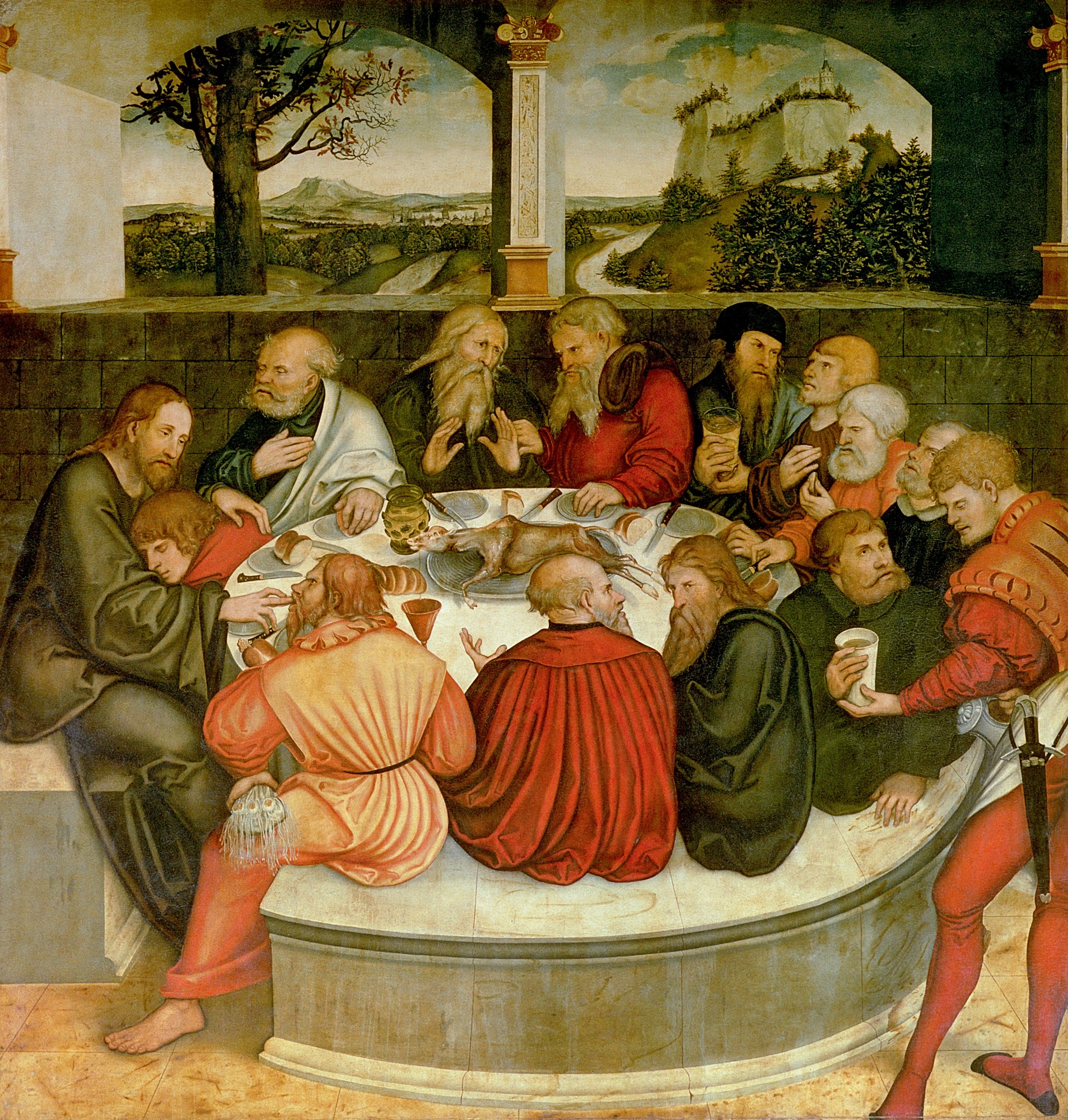
- Lucas Cranach the Elder (about 1472-1553) was Luther’s friend and the Wittenberg court painter. He and his son painted the Wittenberg altarpiece, finished in 1547. P: Cranach Digital Archive, Wittenberg Reformation altarpiece, central panel V1: Concordia Seminary, Lucas Cranach the Elder V2: Deutsche Stiftung Denkmalschutz, Stadtkirche St. Marien (altar).
- Ignatius of Loyola (1491-1556) founded the Jesuits in 1540. They ran schools and missions and became a leading force in the Catholic Reformation. P: Formula of the Institute (1540), Jesuit Portal V1: Catholic Encyclopedia, St. Ignatius Loyola V2: Encyclopedia.com, Saint Ignatius of Loyola.
- Thomas Cranmer (1489-1556) was Archbishop of Canterbury under Henry VIII and Edward VI. He shaped the first Book of Common Prayer (1549). Queen Mary’s government burned him in 1556. P: The Book of Common Prayer (1549) V1: Encyclopedia.com, Thomas Cranmer V2: Encyclopedia.com, Book of Common Prayer.
- Class reading: compare P: Augsburg Confession III-V and IX-XIII P: Apology IV, IX-XIII, and XXIV, and P: Formula VII-VIII. Explain how Christ’s person, justification, and the gifts of the sacraments fit together.
- Ulrich Zwingli taught that Christ’s body is in heaven and that the bread and wine are signs. He denied that Christ’s body is bodily present in the Supper. P: Zwingli, Account of the Faith, eighth article V1: Cameron MacKenzie, Luther and Zwingli at Marburg, PDF pp. 6-9 V2: St Andrews, Council of Trent, section 3.3, Swiss Reformers’ teaching on the Supper. Class study: compare his account with P: Marburg Article 2 on Christ’s person and Article 15 on the Supper and P: Formula VIII.6-13, 76-85. Ask how each side uses Christ’s humanity.
- John Calvin taught that the Holy Spirit joins believers to Christ’s body in the Supper, while Christ’s body stays in heaven. P: Institutes IV.17.10-12 and 18-19 V1: Geoffrey Butler, John Calvin’s Eucharistic Theology V2: Thomas J. Davis, Intermediate Brilliance: Calvin and the Lord’s Supper. Class comparison: set P: Institutes IV.17.19 beside P: Formula VII.35-38 and VIII.76-85. Judge the disagreement by the Lutheran confession, and do not reduce Calvin to a merely symbolic view.
- In On the Jews and Their Lies (1543), Luther urged that Jewish synagogues be burned. P: Luther’s first recommendation, reproduced excerpt V1: Columbia University Libraries, Judaism exhibit, paragraph on the 1543 work V2: Berlin Cathedral and Bach exhibition, paragraph beginning “In 1543”.
- Class evaluation: read that recommendation beside P: Large Catechism, Fifth Commandment, 182-193. Reject the persecution of Jewish neighbors. Keep Luther’s words apart from the standard by which the class judges them. Compare the Lutheran statements that repudiate these words in century 20.
- William Tyndale’s English translation of the Gospels, Acts, letters, and Revelation appeared at Worms in 1526. P: Tyndale, John 1, excerpt V1: Cambridge University Library, The Bible in English V2: Tyndale Society, translations and writings.
- Erasmus’s Greek text of the Gospels, Acts, letters, and Revelation appeared at Basel in 1516. P: Erasmus, Paraclesis V1: Cambridge University Library V2: Museum of the Bible.
- Miles Coverdale’s complete printed English Bible appeared in 1535. P: Coverdale, Prologue to the Reader V1: Cambridge University Library V2: Britannica 1911, Coverdale.
Wider world
- Tenochtitlan, 1521: Spanish forces and Indigenous allies defeated the Mexica (Aztecs) on August 13. P: Cortés, Third Letter, capture of Cuauhtémoc, and Díaz’s siege account, excerpts V1: INAH, Tlatelolco, final resistance and capture V2: National History Museum, glossary, Hernán Cortés entry.
- Magellan-Elcano voyage, 1522: the survivors completed the first voyage around the world. P: Pigafetta, September 6 entry, paragraph 205 V1: UNESCO, expedition of 1519-1522 V2: Bulgarian State Institute for Culture, circumnavigation exhibition.
- Copernicus, 1543: his book On the Revolutions of the Heavenly Spheres, printed at Nuremberg, taught that the Earth moves around the Sun. P: Copernicus, Preface to Pope Paul III V1: Cambridge University, Copernicus’s Book V2: University of Oklahoma Libraries, On the Revolutions of the Heavenly Spheres, 1543.
- Gregorian calendar, 1582: Pope Gregory XIII’s bull Inter gravissimas (“Among the most serious”) dropped ten days. October 4 was followed by October 15, to put Easter back in its proper season. P: Inter gravissimas, English translation V1: Linda Hall Library, Pope Gregory XIII V2: Library of Congress, Inter Gravissimas.
- Class world reading: study P: Cortés’s Second Letter to Charles V. Find his descriptions of the city, its ruler, and its religious practices. Compare his purposes in writing with the claims he makes. Then read it beside P: Augsburg Confession XVI and XXVIII. Ask how the letter presents empire, force, and religion. Ask which sources show how Indigenous peoples answered.
- Class translation comparison. Read Tyndale, John 1 first. Read Erasmus’s Paraclesis second. Read Luther’s Romans preface third. Read Coverdale’s prologue last. Ask how translation carries Christ’s person and saving work to readers. Then compare the Gospel and sacrament passages. Use AC IV-V, IX-X. Use the Small Catechism too. Keep the dates of the first editions apart from the dates of complete Bibles.
Confessional Lutheran connection
- Christ is one person in two natures, truly God and truly human. P: Augsburg Confession III.1-6 V1: Apology III.8 V2: Formula of Concord, Solid Declaration VIII.6-13. Class reading: follow Christ’s incarnation, suffering, resurrection, and rule in Augsburg Confession III.
- Justification (God’s declaration that a sinner is righteous) rests on Christ’s saving work, and faith receives it. It does not rest on the believer’s merits. P: Augsburg Confession IV.1-3 V1: Apology IV.1-6, 43-60 V2: Formula of Concord, Solid Declaration III.9-17.
- Class comparison for Baptism and the Lord’s Supper: read P: Trent VI P: VII P: XIII, and P: XXII beside P: Apology XIII and XXIV and P: Formula VII. Name the words both sides share before you name the disagreement.
- The Wider world entries have no direct tie to Christ’s person or the sacraments. They place the church’s history in its time. Only the new calendar touches the church, through the date of Easter.
Lutheran developments
- Luther’s Ninety-Five Theses (1517) began the Reformation. They call for a debate on indulgences and point to the Gospel as the church’s true treasure. P: Ninety-Five Theses, theses 36 and 62 V1: Schaff, History of the Christian Church VII, section 32 V2: Axel Gotthard, Bundeszentrale für politische Bildung, “Schlaglicht 1517”.
- The Leipzig Debate (June-July 1519): Luther debated Johann Eck. Luther said that popes and councils can err and that Scripture is the final authority. P: Disputation between Eck and Luther, begun July 4, 1519 V1: Lutheran Reformation, The Leipzig Debate V2: Schaff, History of the Christian Church VII, “The Leipzig Disputation”.
- At the Diet of Worms (an imperial assembly) on April 17 and 18, 1521, Luther refused to take back his books. He said only Scripture or clear reason can change his mind. Many say he added “Here I stand.” The earliest records do not contain those words. P: Luther’s speech at Worms, April 18, 1521 V1: City of Worms, The 1521 Diet of Worms V2: Schaff, History of the Christian Church VII, Luther at Worms.
- Luther’s German translation of the Gospels, Acts, letters, and Revelation appeared in 1522. He made it while he was hidden at the Wartburg castle after Worms. P: Luther, Preface to Romans V1: Gruber Collection, 1522 V2: Cambridge University Library.
- Luther’s complete German Bible appeared in 1534. P: Luther Bible title page, transcription V1: Gruber Collection, 1534 V2: Library of Congress, Dresden exhibition.
- Luther published his Large and Small Catechisms in 1529. They teach the Ten Commandments, the Creed, the Lord’s Prayer, Baptism, and the Lord’s Supper. P: Large Catechism, Preface V1: Bente, Historical Introductions, the catechisms of 1529 V2: LCMS, The Large and Small Catechisms of Dr. Luther.
- The Augsburg Confession was presented to Charles V on June 25, 1530. P: Melanchthon’s letter to Luther dated June 25, quoted in Bente, section 24 V1: Kilcrease, The Presentation of the Augsburg Confession V2: The Texts of the Lutheran Confessions.
- Lutheran princes and cities formed the Smalcald League in February 1531 for mutual defense. P: Bente, Historical Introductions, the Smalcald League V1: Encyclopedia.com, Schmalkaldic League V2: EBSCO Research Starters, Schmalkaldic League.
- The Smalcald Articles (1537): Luther wrote them to state the points on which Lutherans stand, because the pope had called a church council. They were prepared for a meeting of the Smalcald League at Smalcald in February 1537. Luther fell ill there and left in poor health. His fellow theologians signed the Articles. P: Smalcald Articles, Preface 1-2 V1: Bente, Historical Introductions, the Smalcald Articles V2: Schaff, Creeds of Christendom, volume I, Smalcald Articles.
- Luther died at Eisleben on February 18, 1546. A note found after his death ends, “We are beggars. This is true.” P: Luther’s last written words, February 16, 1546 V1: Kilcrease, The Death of Luther V2: Catholic Encyclopedia, Martin Luther.
- Smalcald War (1546-1547): Charles V’s army defeated the Smalcald League at Mühlberg on April 24, 1547. Elector John Frederick of Saxony was captured. Titian painted Charles as the victor in 1548. P: Titian, Charles V at Mühlberg (1548), image record V1: EBSCO Research Starters, Schmalkaldic War V2: Encyclopedia.com, Mühlberg.
- Interims (1548): Charles V ordered the Augsburg Interim in the spring of 1548. It told Protestants to return to Catholic practice until a council met, but it allowed married clergy and Communion with both bread and wine. Lutherans in Saxony then produced the Leipzig Interim. Later Lutherans judged it too yielding. P: Formula of Concord, Solid Declaration, Preface 3-5, on the dispute over the Interim V1: LCMS, The Augsburg Interim V2: Catholic Encyclopedia, Interims.
- The Adiaphoristic Controversy: Melanchthon and others agreed to keep some Catholic ceremonies in the Leipzig Interim as adiaphora (things neither commanded nor forbidden). Flacius and others said that yielding in a time of confession is wrong. The Formula of Concord X sides with Flacius on this point. P: Formula of Concord, Solid Declaration X, Church Rites V1: Catholic Encyclopedia, Interims V2: Concordia Lutheran Conference, The Adiaphoristic Controversy.
- The Peace of Augsburg (September 25, 1555) let each ruler in the Empire choose between the Catholic faith and the Augsburg Confession for his lands. Subjects of the other faith had the right to move away. Reformed (Calvinist) churches were left out. P: The Religious Peace of Augsburg, September 25, 1555 V1: Encyclopedia.com, Augsburg, Peace of V2: EBSCO Research Starters, Peace of Augsburg.
- The Formula of Concord reached its signed form in 1577. P: signers’ declaration and dated record, quoted in Bente, section 282 V1: Concordia Historical Institute, Martin Chemnitz at 500, “Concord Co-Author” V2: CPH, The Development of the Formula of Concord, final revision.
- The German Book of Concord was published in Dresden in 1580. It was released on June 25, fifty years after the Augsburg Confession was presented. P: title-page imprint, “Anno 1580,” in Bente, section 2 V1: CPH, facsimile edition description V2: Christian History Institute, the Dresden publication.
- Class reading sequence: read P: Augsburg Confession P: Apology P: Smalcald Articles P: Treatise P: catechisms, and P: Formula. Follow the main questions across these texts.
